Decentralization for Improved Democratic Education (DECIDE): Promotion of democratic education in Ukraine
Auch auf Deutsch verfügbar
Content of this page
Profile
- Project leadership
- Corinna Borer (PHZH)
- Project team
- Valentyna Poltorak (NGO DOCCU), Rolf Gollob (Emeritus of PHZH, Project Associate), Nadine Ritzer (PHZH), Denise Hungerbühler Schmidt (PHZH)
- Organisational unit
- W-IB-GBZ (Globale Bildung und Zusammenarbeit)
- Project phase
- In progress (1.10.2019 – 31.8.2030)
- Project type
- Service project
- Funding
- Swiss Agency for Development and Cooperation
- Participating institutions
- NGO DOCCU, Ukraine
Description
The Decentralization for Improved Democratic Education (DECIDE) project supports schools and authorities in implementing the ongoing “New Ukrainian School” education reform. The aim is to decentralise the organisation of the education system so that schools and authorities can act democratically and autonomously.
With the outbreak of war on 24 February 2022 and after consultation with the regional office of the Swiss Agency for Development and Cooperation, the project temporarily took on humanitarian tasks, assisting refugee students, their parents and also teachers. Meanwhile, the project has refocused on further long-term reforms and the improvement of school infrastructure. In addition, the DECIDE-VET part of the project strengthens vocational training and supports young people in their transition from school to the workplace.
At the Ukraine Recovery Conference in Rome in July 2025, the decision was made to extend the DECIDE project until 2030. During the second phase, the scope of DECIDE’s activities will be expanded to encompass nine regions and 40 municipalities. Additionally, local authorities will receive support to modernise educational structures and establish a career guidance system with Swiss support. This will build on the subject knowledge of PH Zurich and the “JOBS” teaching material, which was successfully tested during the first phase.
DECIDE is a project of the Department for International Projects in Education.
News about the project
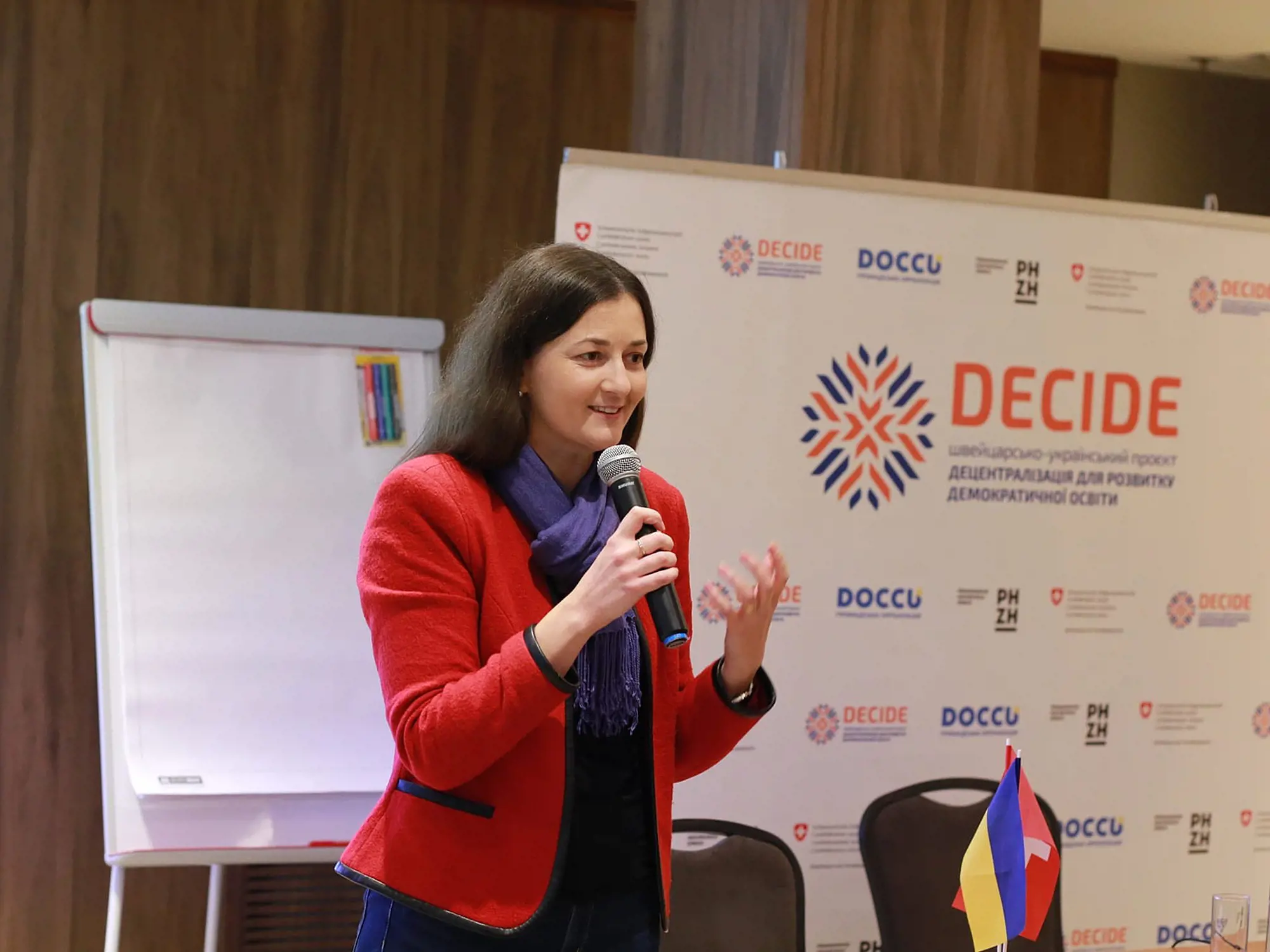


Project outcomes
An image gallery with 9 images follows.


Despite the continuing impact of the war in Ukraine, which has taken an economic, infrastructural and human toll, the DECIDE project has succeeded in transferring decision-making powers and resources from central authorities to local administrations. This has promoted local democratic solutions and increased public participation. At the same time, DECIDE has played a crucial role in supporting the ongoing restructuring of the school network through the NUS reform and, through the DECIDE-VET component, the reform of vocational education and training. Concrete project outputs until July 2025 include, among others:
- Conducted webinars with participants from 1411 hromadas (territorial communities), training 385 mayors and education managers in 257 hromadas, in cooperation with the Association of Hromadas, the National Agency of Ukraine for Public Service and other partners.
- Reached more than 500’000 students in non-violent communication and teachers in Education for Democratic Citizenship and Human Rights (EDC/HRE).
- Trained 20’000 educators, 95 master trainers and more than 7000 teachers of inclusive resource centres in EDC/HRE.
- Provided for psycho-social support through the production of webinars for educational institutions (with 35’000 users).
- Developed a career guidance programme for grades 7–9 and trained teachers to effectively support students in their transition from school to further education or vocational pathways.
- Developed 272 mini-projects in 16 hromadas (e.g. creating a lounge area in a school or a gym in a shelter), of which 108 were selected for implementation through public voting
- Contributed to the renovation of shelters, benefiting some 17’000 students in 24 schools in Chernihiv, Odesa and Poltava oblasts.
Through these efforts, the DECIDE project has made significant progress in institutionalising and mainstreaming its results at local, regional and national levels. In addition, by addressing the needs of vulnerable groups such as internally displaced persons (IDPs) and children with disabilities, and by promoting inclusive decision-making, DECIDE has increased the social relevance and acceptance of its initiatives. While the reform of the NUS at the pre-primary and primary levels is formally complete, the project is continuing in a second phase with a focus on expanding activities and career guidance until 2030.