Becoming a teacher through the Swiss educational system
Content of this page
Universities of teacher education in Switzerland
In Switzerland, the majority of teacher training for primary education (including pre-primary and lower primary), lower secondary education, vocational schools, advanced vocational schools and specialised schools, as well as for teaching professions in the field of therapeutic pedagogy, takes place at universities of teacher education. The degree programmes offered there qualify graduates to work in the field and combine theory, practice, teaching and research. The courses follow the two-tier model with bachelor’s and master’s degree programmes, and graduates receive teaching and professional diplomas upon completion that are recognised throughout Switzerland.

Recognition of foreign teaching diplomas
Foreign teaching qualifications are normally recognized in Switzerland if the training and the range of subjects are equivalent to those required for Swiss teaching diplomas, and if skills in one of the national languages – German, French or Italian − are satisfactory.
The Swiss Conference of Cantonal Ministers of Education (EDK) in Berne is responsible for the recognition of foreign teaching diplomas. Provided that the foreign diploma largely meets Swiss criteria and that the language prerequisites are fulfilled (see below), the teaching diploma will be recognised in Switzerland.
If there are considerable differences in the educational content, recognition is deferred until compensatory measures have been satisfactorily completed. These may take place at the PH Zurich, if the student has the necessary German language skills.
For more information on the recognition of international teaching qualifications, please visit the website of the Swiss Conference of Cantonal Ministers of Education (EDK) (in German).
Language prerequisites
As part of the recognition of foreign teaching diplomas, candidates must provide proof of sufficient language skills in one of the main Swiss national languages (German, French or Italian). As proof of such language skills in German, French or Italian, an internationally recognised language diploma at Level C2 on the Common European Framework of Reference for Languages (CEFR) is required. This may have been acquired in Switzerland or abroad.
For teachers at secondary I level and baccalaureate schools who only teach a language that is not a Swiss national language (e.g. English) as a foreign language and therefore do not necessarily have to teach using one of the national languages, an international language diploma for German, French or Italian at B2 Level on the CEFR is sufficient.
The Swiss educational system
Compulsory schooling
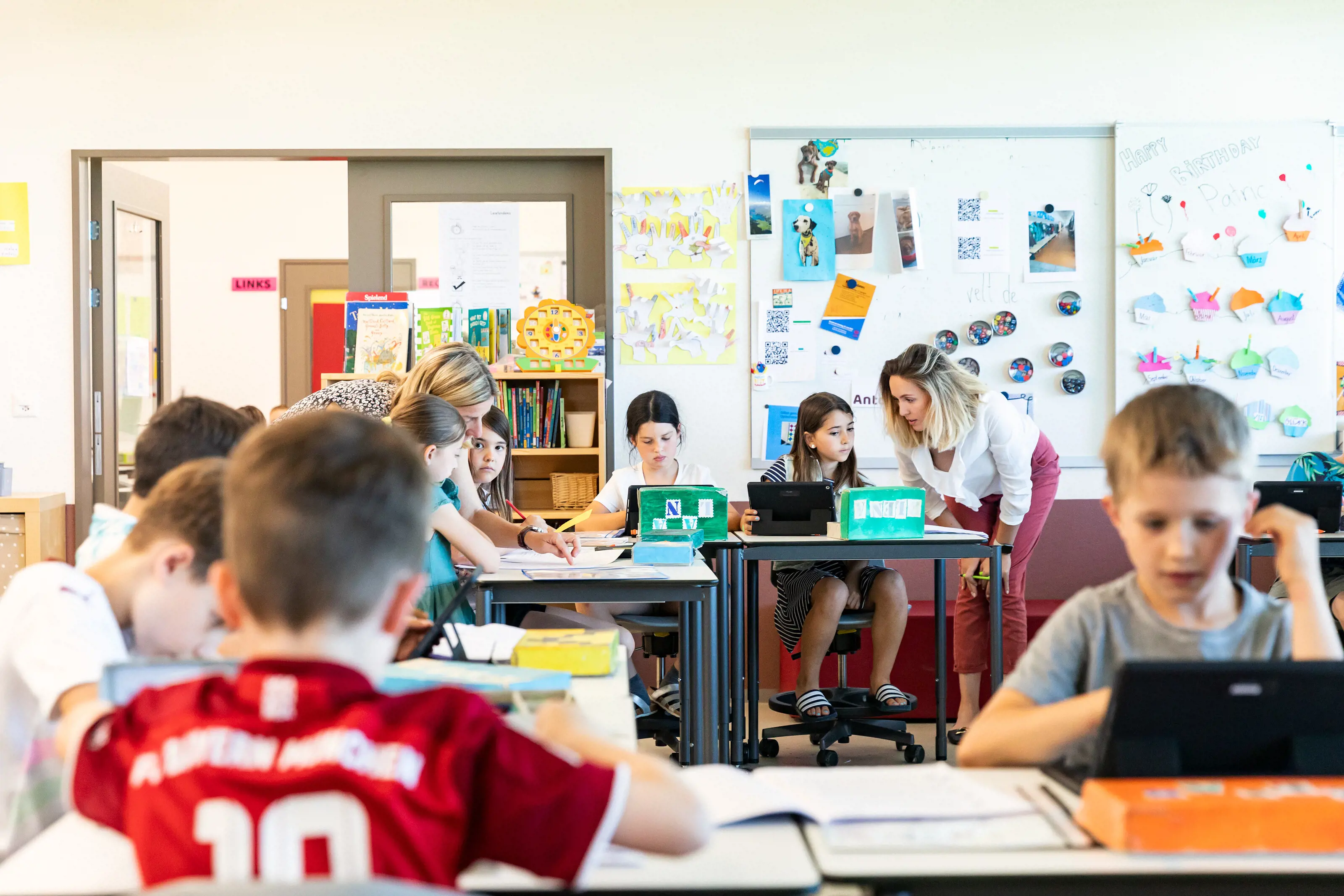
Compulsory education in Switzerland spans 11 years and usually begins at the age of four. Primary education lasts eight years and includes the first two years of pre-school. The next level is known as lower secondary education; this lasts three years everywhere in Switzerland except Ticino, where it lasts four years.
The individual cantons are responsible for how compulsory schooling is structured. They set the curricula and timetables, and determine what teaching materials are used. Curricula specific to the language regions are used throughout the country as part of this: the Lehrplan 21 curriculum project in German-speaking Switzerland, the Plan d’études romand (PER) project in French-speaking Switzerland and the Piano di studio in the canton of Ticino. The municipalities are
responsible for organising how the schools are run.
Upper secondary education and vocational education and training
After completing their compulsory schooling, young people move into upper secondary education. Here, they have two options: the first is to either attend a school that allows them to complete a (general) baccalaureate, or go to a specialised school, most of which also prepare students for university. The second option is to complete a vocational training course, which is what the majority of young people in Switzerland choose. Here, pupils complete a VET programme while attending a vocational school or an advanced vocational school at the same time. Many vocational qualifications in Switzerland are acquired at upper secondary level, whereas the acquisition of the same qualifications takes place at tertiary level in other countries.
Young people usually finish upper secondary education at the age of 18 or 19, and obtain a corresponding certificate of completion. More than 90% of young people get a qualification at this level.
Institutions of higher education and advanced vocational education and training
At the tertiary level, the Swiss educational system offers a wide range of courses that can be completed at an institute of higher education – such as a university, university of applied sciences or university of teacher education – or as part of an advanced vocational education and training (VET) programme. An advanced VET programme enables professionals who have completed basic vocational training to specialise in a field and deepen their subject knowledge.
You can find out more about the Swiss educational system on the website of the Swiss Conference of Cantonal Ministers of Education (EDK).