Mathematics education
Auch auf Deutsch verfügbar
Content of this page
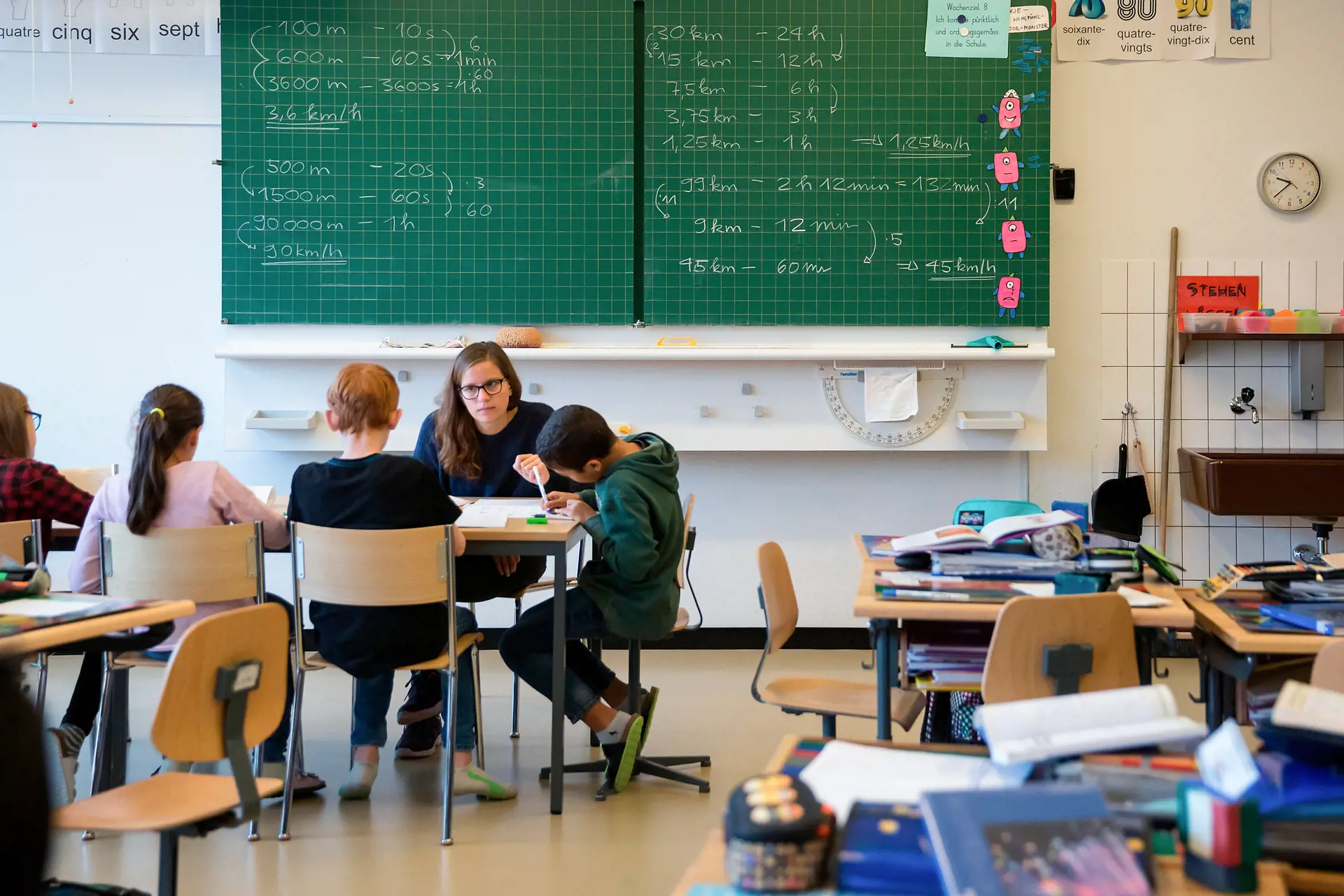
Mathematics education at the PH Zurich looks at questions concerning assessment and promotion as well as the professionalisation of teachers in the subject of mathematics, using the topics of understanding multiplicative relationships, flexible arithmetic, probability, conversion between place value systems and understanding lengths as examples.
Quantitative and qualitative research methods are used to research mathematics education, from multi-perspective, mixed-methods designs to narrowly focused, randomised control studies. Mathematics education approaches specific to the learning topics are linked and supplemented with pedagogical-psychological or general pedagogical theories. In this way, mathematics education deals with questions that form part of basic research, as well as questions whose findings are used directly in schools and in the training and continuing education of mathematics teachers.
The Mathematics Education Research Group deals with mathematics education at PH Zurich.
Research focuses
Learning and teaching mathematics is both challenging and fascinating at the same time. The research being conducted in the area of mathematics education focuses on three questions.
Assessing and promoting
In this thematic focus, specific subject-related comprehension processes are analysed and tools are developed to promote them. This includes the development, evaluation and implementation of assessment and support tools for individual learners as well as for learning groups in schools and universities.
Effect chain: it’s all about the teacher
This thematic focus looks at various larger and smaller sections of the effect chain, which extends from the training and continuing education of teachers to the professional knowledge of teachers, the quality of teaching and learners’ acquisition of skills. Having a better understanding of this effect chain and providing effective offerings for developing lessons on mathematics education promotes training and continuing education at PH Zurich.
Intelligent tutoring systems
Computer-based intelligent tutoring systems (ITS) are being developed and evaluated. These support learners by providing immediate feedback on the steps they take to solve a problem, not just on the result they end up with. The basis for this are empirically validated models of learning topics and learning developments.
Other projects
Publications
2026
Mayer, D. & Drollinger-Vetter, B. (2026)
Interaktion als zentraler Bestandteil mathematischer Basiserfahrungen.
In: L. Amberg, L. Bürgi, P. Chiavaro-Jörg, C. Burkhardt Bossi, K. Herger, J. Hostettler Schärer & K. Landert Born (Hrsg.), Interaktion als Dreh- und Angelpunkt erfolgreichen Lehrens und Lernens (S. 201–218). Waxmann.
2025
Drollinger-Vetter, B., Buff, A., Lipowsky, F., Philipp, K., & Vogel, S. (2025) Fostering pedagogical content knowledge on “probability” in preservice primary teachers within formal teacher education: A longitudinal experimental field study.
Teaching and Teacher Education, 159, 104953.
Maskos, Karolin, Andreas Schulz, Selin S. Oeksuez and Katrin Rakoczy (2025) Formative Assessment in Mathematics Education: A Systematic Review.
ZDM Mathematics Education, 57: 679–93.
2024
Drollinger-Vetter, Barbara (2024) Verknüpfen, Verdichten und Auffalten als zentrale Prozesse des Verstehens und ihr Zusammenhang mit Verstehenselementen.
In: Mathematikdidaktische Impulse aus Vergangenheit und Gegenwart, hrsg. von Gabriella Ambrus, Johann Sjuts und Eva Vásárhelyi, 11–24. Münster: WTM.
Leuenberger, Delia, Marion Diener, Maria Wehren-Müller, Andreas Hofmann-Villiger, Franziska Vogt and Elisabeth Moser Opitz (2024) Fostering Computation Competence with Non-Counting Strategies and Conceptual Subitizing in Grade 1: An Intervention Study in Inclusive Classrooms.
Journal für Mathematik-Didaktik 45 (12): 1–30.
Oeksuez, Selin, Alois Buholzer, Karolin Maskos and Andreas Schulz (2024) Theoriebasierte Entwicklung einer Weiterbildung zu fachspezifischem formativem Peer- und Self-Assessment.
In: Pädagogische Diagnostik und Lehrer:innenbildung. Bildungswissenschaftliche und fachdidaktische Perspektiven, hrsg. v. Claudia Schreiner, Gabriela Schauer und Christian Kraler, 107–18. Bad Heilbrunn: Verlag Julius Klinkhardt.
Schulz, Andreas and Johannes Voermanek (2024) Problemlösestrategien für Kombinatorikaufgaben – eine Online-Lernumgebung für Primarschulstudierende.
In: Förderung prozessbezogener Kompetenzen mit digitalen Medien, hrsg. v. Christina Bierbrauer, Silke Ladel und Melanie Platz, 200–19. Münster: WTM-Verlag.
Schulz, Andreas (2024) How Do Multiplicative and Relational Thinking Contribute to Multidigit Division?
Journal für Mathematik-Didaktik 45 (21).
2023
Foster, Manuela, Marion Diener, Susanne Schnepel & Elisabeth Moser Opitz (2023) Individuelle Lernunterstützung in der Arbeitsphase einer standardisierten Mathematikstunde im ersten Schuljahr – eine Videostudie.
Unterrichtswissenschaft: 1–28.
Schulz, Andreas (2023) Assessing student teachers’ procedural fluency and strategic competence in operating and mathematizing with natural and rational numbers.
Journal of Mathematics Teacher Education: 1–28.
Voermanek Johannes and Andreas Schulz (2023) Which promotes learning success and acceptance better? Experimental comparison between an intelligent and a passive online learning environment.
Inted2023 Proceedings.
Voermanek, Johannes und Andreas Schulz (2023) Zusammenhänge zwischen Motivation, Akzeptanz und Nutzung einer intelligenten versus passiven Lernumgebung.
In: Digitaler Mathematikunterricht in Forschung und Praxis, hrsg. v. Frederik Dilling, Daniel Thurm und Ingo Witzke, 223–32. Münster: WTM Verlag.
2022
Mayer Dorothea and Margret Schmassmann (2022) Zählen, ordnen, vergleichen. Mathematik in der Kita kennenlernen./Impulse: Zählkompetenz von Kindern fördern.
Kindergarten heute. Fachzeitschrift für Kindergarten. Februar, Nr. 2/2022, 52. Jg.
Mayer Dorothea and Margret Schmassmann (2022) Warum fragt die Lehrerin warum? Erforschen und Argumentieren im Mathematikunterricht.
“4 bis 8”. Fachzeitschrift für Kindergarten. April, Nr. 3/2022.
Schulz Andreas (2022) Online-Assessment für angehende Primarschullehrpersonen zur prozeduralen Geläufigkeit und strategischen Kompetenz.
In: J Bonow, T. Dexel, R. Rink, Chr. Schreiber & D. Walter (Hrsg.): Digitale Medien und Heterogenität. Chancen und Herausforderungen für die Mathematikdidaktik. Münster: WTM. S. 261–275.
Schulz Andreas (2022) Wie und mit welchem Erfolg dividieren angehende Primarlehrpersonen natürliche Zahlen, gemischte Brüche und Dezimalzahlen? Eine fokussierte Analyse mathematischen Wissens von Studienanfängern mit Folgerungen für die Ausbildung.
Tagungsband der 5. Tagung Fachdidaktiken in Locarno. Swissuniversities. S. 496–502.
Schulz Andreas, Alexander Aichinger and Martina Hartl (2022) Bildungsstandards Mathematik – von der Theorie zur Nutzung.
In: A. George, S. Götz, M. Illetschko & E. Süss-Stepancik (Hrsg.): Empirische Befunde zu Kompetenzen im Mathematikunterricht der Sekundarstufe 1 und Folgerungen für die Praxis. Ergänzende Analysen zu den Bildungsstandardüberprüfungen. Waxmann. S. 15–54.
2020
Schulz Andreas, Timo Leuders and Ulrike Rangel (2020)
The Use of a Diagnostic Competence Model About Children’s Operation Sense for Criterion-Referenced Individual Feedback in a Large-Scale Formative Assessment.
Journal of Psychoeducational Assessment, 38 (4),p. 426–444.
Doctoral theses
Formative assessment in primary school mathematics education
Doctoral thesis by: Karolin Maskos
Topic: Peer and self-assessment have been empirically under-researched in the context of formative assessment in mathematics education, despite their potential to promote student learning. At the same time, video studies show that teachers have a need for professional development regarding the effective implementation of these approaches. The project “Formative Assessment in Mathematics Education – FORMA” addresses this by developing an innovative continuing education program for primary school teachers. This program demonstrates ways to implement peer and self-assessment in mathematics classes using multiplication and division as an example, with novel teaching materials and practical videos. In her dissertation, Karolin Maskos explores the extent to which the interdisciplinary intervention carried out as part of the FORMA project influences the mathematical learning of 4th and 5th graders. Karolin Maskos also investigates the effect of the continuing education program on the teachers’ subject-specific professional knowledge and its influence on student learning.
Founded by: Swiss National Science Foundation (SNSF)
Supervisors: Andreas Schulz (PHZH) and Kai Niebert (University of Zurich)