Physical education
Auch auf Deutsch verfügbar
Content of this page
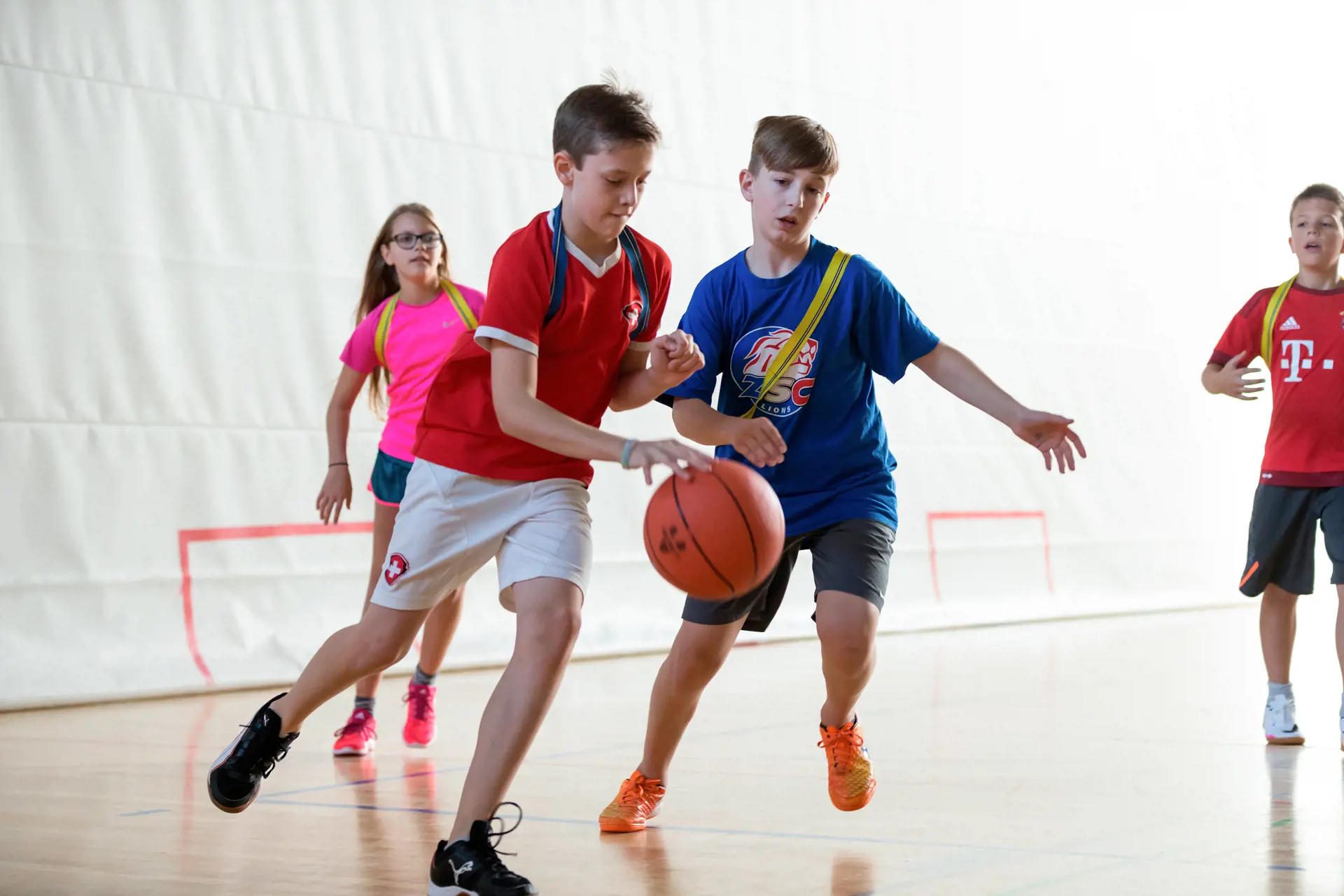
Research is conducted into the prerequisites, processes and effects of sports activities inside and outside of the school environment. Children and young people successfully developing their skills and maintaining their well-being are the concerns at the heart of this work. The focus is on skills relating to sports and exercise, such as basic motor competencies, with potential influencing factors being identified and teaching methods being developed with the aim of supporting children and young people. Overall, the research makes a significant contribution to improving the quality of teaching and learning in physical education. Interdisciplinary competencies (such as life skills) and aspects relating to physical, mental and social health are also investigated.
Research in this area is led by the Physical Education Research Group. Within the context of empirical educational research, the group advocates for physical education based on problem-solving, an interdisciplinary approach and the use of empirical research methods.
Research focuses
Physical education conducts research into the following focus areas:
- Development, validation and implementation of a learning-topic-based quality model for teaching and learning. Observation, development and promotion of basic motor competencies in childhood
- Links between physical education, life skills and health
- Development, implementation and evaluation of extracurricular sporting activities at all-day schools or schools with daytime structures
Quality of teaching and learning
High-quality physical education allows children and young people to successfully develop their skills and encourages them to stay active through sporting activities. Descriptions and evaluations of the quality of physical education on the basis of specific criteria make it possible to keep database records of teaching activities and action planning that can be used for ongoing reflection. This paves the way for teacher education to evolve and develop in innovative ways. That is the reason behind the focus on research into the quality of teaching and learning within the Physical Education Research Area.
Basic motor competencies in childhood
Basic motor competencies (BMCs) are special skills that need to be developed as a prerequisite for children to actively participate in physical education. They are closely linked to the physical and mental health of children and young people. With a view to covering the basic motor competencies in the curriculum in an age-appropriate manner, basic motor competency testing tools have been developed for children between the pre-primary and lower secondary levels. Research in this area investigates the development of motor competencies and interdisciplinary skills in children and young people using empirical methods. The results are used to systematically develop and implement teaching formats and learning environments.
Sport, life skills and health
The aim within this focus area is to investigate the links between motor competencies, life skills and health-related factors in children. This is based on the understanding that motor competencies and life skills have close ties to health-related factors such as the social integration and well-being of children. For example, social interactions within the context of physical education can have a positive impact on the development of motor competencies and life skills (such as interpersonal skills and self-awareness).
Extracurricular sporting activities at all-day schools
Teaching is closely intertwined with pastoral care at all-day schools, with teachers and other school staff working closely together. Pupils have the opportunity to take part in extracurricular activities that can support their learning outside of the classroom. The focus of research in this area is the development and evaluation of the quality of extracurricular sporting activities and the crossovers with these activities in terms of teaching and pastoral care. The impact of these activities on the school system and the well-being of individuals in the school setting is also investigated.
Other projects
Publications
2025
Bretz, Kathrin (2025) Das Zusammenspiel aus motorischen Kompetenzen, deren Selbstwahrnehmung und gesundheitsbezogenen Faktoren in der Kindheit.
Hamburg: Staats- und Universitätsbibliothek.
Ferrari, Ilaria, Johanna Kress, Nicolas Voisard, Benoît Lenzen, Patrizia Bernasconi, Kathrin Bretz and Christian Herrmann (2025) Développement moteur et activité physique dans l’enfance – relation entre les capacités motrices de base et les activités de loisirs des enfants en Suisse romande.
Mouvements & Sciences du Sport / Science & Motricité. 129: 47–56.
Ferrari, Ilaria, Kathrin Bretz, Johanna Kress, Lukas Niederberger and Patricia Schuler Braunschweig (2025) Sport Activities in Extended Education – Their Leading Role for Educational Development.
Frontiers in Education 10: 1545842.
Ferrari, Ilaria, Patricia Schuler Braunschweig, Johanna Kress, Kathrin Bretz and Lukas Niederberger (2025) The Open Gym – An Active (Lunch)time Offering at All-Day Schools.
Frontiers in Sports and Active Living 7: 1543771.
Giuriato, Matteo, Alessandro Gatti, Marco Del Bianco, Agnese Pirazzi, Caterina Cavallo, Simone Balconi, Vittoria Carnevale Pellino, Christian Herrmann, Roberto Codella, Matteo Vandoni and Nicola Lovecchio (2025) Basic Motor Competencies in Italian Schoolchildren Using the MOBAK-Test: Normative Data for a Novel Framework.
European Journal of Sport Science 25(12): e70084.
Ludyga, Sebastian and Christian Herrmann (2025) The association of motor competence and executive function across primary school years.
Psychology of Sport and Exercise 80: 102895.
Novotná, Tamara, Ingrid Ružbarská, Daniela Falat Leűtterová and Johanna Kress (2025) Motor Competence in Primary School Children: A Comparative Study of Two Assessment Methods
Journal of Physical Education and Sport 25(7): 1423–29.
2024
Herrmann, Christian, Harald Seelig and Fabienne Ennigkeit (2024) Motorische Basiskompetenzen. Konstrukt, Erfassung und Anwendung.
Wiesbaden: Springer VS.
Bretz, Kathrin, Ilaria Ferrari, Johanna Kress and Christian Herrmann (2024) Development of Basic Motor Competencies and Connections with Sport Participation.
Current Issues in Sport Science 9 (2).
Ferrari, Ilaria, Johanna Kress, Simone Storni, Flavio Rossi, Alejandro Arigoni, Kathrin Bretz and Christian Hermann (2024) Sviluppo motorio e movimento in età infantile.
Orientamenti Pedagogici 71 (3): 31–45.
Kress, Johanna, Kathrin Bretz, Christian Herrmann, Patricia Schuler and Ilaria Ferrari (2024) Profiles of Primary School Children’s Sports Participation and Their Motor Competencies.
Children 11, 1370: 1–18.
Lenzen, Benoît, Christelle Hayoz, Ilaria Ferrari, Serge Weber, Daniel Deriaz and Nicolas Voisard (2024) Co-élaborer des ressources curriculaires en EPS pour l’enseignement primaire en Suisse, au carrefour des épistémologies professionnelles et des cultures linguistiques.
eJRIEPS 54: 1–24.
Carcamo-Oyarzun, Jaime, Erin Gerlach, Kathrin Bretz and Christian Herrmann (2024) Die Beziehung motorischer Basiskompetenzen chilenischer Schüler*innen mit deren Motivation, Einstellung und körperlicher Aktivität.
In: Motorische Basiskompetenzen. Konstrukt, Erfassung und Anwendung, hrsg. von Christian Herrmann, Harald Seelig und Fabienne Ennigkeit, 189–208. Wiesbaden: Springer VS.
Giese, Martin, and Christian Herrmann (2024) Motorische Basiskompetenzen von Kindern und Jugendlichen mit Blindheit und Sehbehinderung – Eine Pilotstudie mit dem MOBAK-5–6 Testinstrument.
In: Motorische Basiskompetenzen. Konstrukt, Erfassung und Anwendung, hrsg. von Christian Herrmann, Harald Seelig und Fabienne Ennigkeit, 71–92. Wiesbaden: Springer VS.
Gramespacher, Elke, Christian Herrmann, Fabienne Ennigkeit, Christopher Heim and Harald Seelig (2024) Geschlecht – ein Prädiktor für motorische Basiskompetenzen. Eine Studie mit MOBAK-Daten von Drittklässler*innen.
In: Motorische Basiskompetenzen. Konstrukt, Erfassung und Anwendung, hrsg. von Christian Herrmann, Harald Seelig und Fabienne Ennigkeit, 35–46. Wiesbaden: Springer VS.
Herrmann, Christian (2024) Erfassung motorischer Basiskompetenzen – Die MOBAK-Testinstrumente.
In: Motorische Basiskompetenzen. Konstrukt, Erfassung und Anwendung, hrsg. von Christian Herrmann, Harald Seelig und Fabienne Ennigkeit, 15–32. Wiesbaden: Springer VS.
Ludyga, Sebastian and Christian Herrmann (2024) Exekutive Funktionen als Korrelate motorischer Leistungen im Kindes- und Jugendalter.
In: Motorische Basiskompetenzen. Konstrukt, Erfassung und Anwendung, hrsg. v. Christian Herrmann, Harald Seelig und Fabienne Ennigkeit, 119–40. Wiesbaden: Springer VS.
Niederkofler, Benjamin, Ilaria Ferrari, Jürgen Kühnis and Christian Herrmann (2024) Diagnostische Kompetenz von Lehrpersonen in der Einschätzung der motorischen Basiskompetenzen von Kindern.
In: Motorische Basiskompetenzen. Konstrukt, Erfassung und Anwendung, hrsg. v. Christian Herrmann, Harald Seelig und Fabienne Ennigkeit, 209–25. Wiesbaden: Springer VS.
Wälti, Marina, Fabienne Ennigkeit, Michaela Ruffing, Christopher Heim, Uwe Pühse and Christian Herrmann (2024) Motorische Basiskompetenzen und gesundheitsbezogene Lebensqualität in der Grundschule.
In: Motorische Basiskompetenzen. Konstrukt, Erfassung und Anwendung, hrsg. v. Christian Herrmann, Harald Seelig und Fabienne Ennigkeit, 141–62. Wiesbaden: Springer VS.
Crapa, Angelo, Ilaria Ferrari and Christian Herrmann (2024) Lernaufgaben qualitätsvoll gestalten: Sportunterricht mit dem QUALLIS-Unterrichtsqualitätsmodell planen und umsetzen.
Sportunterricht 73 (11): 507–13.
Herrmann, Christian and Angelo Crapa (2024) Qualität des Lehrens und Lernens im Sportunterricht: Das QUALLIS-Unterrichtsqualitätsmodell.
Sportunterricht 73 (11): 484–91.
2023
Baumberger, Jürg (2023) Kompetenzförderliche Beurteilung mithilfe des Sportjournals.
Sportunterricht 72 (8): 349–54.
Baumberger, Jürg und Simone Bislin (2023) Umgang mit heterogenen Voraussetzungen in Sportspielen.
Sportunterricht 72 (10): 441–47.
Bretz, Kathrin, Johanna Kress, Ilaria Ferrari und Christian Herrmann (2023) Auf die Familie kommt es an? Zur Bedeutung familiärer Faktoren für die motorischen Basiskompetenzen von Kindern.
Sportunterricht 72 (4): 156–62.
Carcamo-Oyarzun, Jaime, Christian Herrmann, Erin Gerlach, Sonia Salvo-Garrido und Isaac Estevan (2023) Motor competence, motivation and enjoyment in physical education to profile children in relation to physical activity behaviors.
Physical Education and Sport Pedagogy: 1–16.
Ferrari, Ilaria, Steinmann Patricia und Christian Herrmann (2023) Lernaufgaben zur Förderung der motorischen Kompetenzen im Kindergarten.
Sportunterricht 72 (4): 175–80.
Gonzalez-Huenulef, Yinali, Pia Martino-Fuentealba, Kathrin Bretz, Cristina Ferbol und Jaime Carcamo-Oyarzun (2023) Competencia motriz real y percibida en niños y niñas de la Patagonia Chilena: La percepción del estudiantado y del profesorado de Educación Física.
Retos 50: 290–97.
Herrmann, Christian, Benjamin Niederkofler und Harald Seelig (2023) Assessment of teaching and learning quality in physical education – Validation of the QUALLIS instrument.
Swiss Journal of Educational Research 45 (2): 202–19.
Herrmann, Christian, Sara Seiler, Anna Siffert, Venera Gashaj und Fabian Studer (2023) Entwicklung und Validierung eines Evaluationsinstruments zur Erfassung der Qualität des Lehrens und Lernens im Schweizer Kinder- und Jugendsport.
Forum Kinder- und Jugendsport 4 (2): 88–101.
Kress, Johanna, Harald Seelig, Kathrin Bretz, Ilaria Ferrari, Roger Keller, Jürgen Kühnis, Simone Storni und Christian Herrmann (2023) Associations between basic motor competencies, club sport participation, and social relationships among primary school children.
Current Issues in Sport Science 8 (1): 1–21.
Wälti, Marina, Harald Seelig, Manolis Adamakis, Dario Colella, Arūnas Emeljanovas, Erin Gerlach, Irene Kossyva, Jana Labudová, Dana Masaryková, Brigita Miežienė, Remo Mombarg, Domenico Monacis, Benjamin Niederkofler, Marcos Onofre, Uwe Pühse, Ana Quitério, Jeffrey Sallen, Claude Scheuer, Petr Vlček, Jaroslav Vrbas und Christian Herrmann (2023) Investigating levels and determinants of primary school children’s basic motor competencies in nine European countries.
Zeitschrift für Grundschulforschung 16 (1): 113–33.
Ferrari, Ilaria, Kathrin Bretz und Patricia Schuler Braunschweig (2023) Bewegungs- und Sportangebote in der Tagesschule – partizipative Auswahl.
In: Tagesschulen im Fokus. Akteurinnen – Kontexte – Perspektiven*, hrsg. v. Patricia Schuler Braunschweig und Christa Pra, 93–110. Bern: hep Verlag.
2022
Bretz, Kathrin, Harald Seelig, Ilaria Ferrari, Roger Keller, Jürgen Kühnis, Simone Storni und Christian Herrmann (2022) Basic Motor Competencies of (Pre)School Children: The Role of Social Integration and Health-Related Quality of Life.
IJERPH 19 (21): 14537.
Ferrari, Ilaria, Patricia Schuler, Kathrin Bretz, Jessica Bär, Marianne Rast and Lukas Niederberger (2022) Pop-Up Systems – Innovative Sport and Exercise-Oriented Offerings for Promoting Physical Activity in All-Day Schools.
Sustainability 14, no. 5: 3090.
Ferrari, Ilaria, Jürgen Kühnis, Kathrin Bretz und Christian Herrmann (2022) Diagnostische Kompetenz der Lehrpersonen und deren didaktischen Implikationen in der Förderung motorischer Basiskompetenzen.
In: R. Messmer & C. Krieger (Hrsg.), Narrative zwischen Wissen und Können. Aktuelle Befunde aus Sportdidaktik und ‑pädagogik (S. 177–196). Baden-Baden: Academia.
Herrmann, Christian, Kathrin Bretz, Johanna Kress und Harald Seelig (2022) Development of Basic Motor Competencies During Childhood (EMOKK): Documentation of Items and Scales – Survey.
Zenodo.
2021
Herrmann, Christian, Kathrin Bretz, Jürgen Kühnis, Harald Seelig, Roger Keller and Ilaria Ferrari (2021) Motorische Basiskompetenzen im Kindergarten: Monitoring und Zusammenhänge mit Geschlecht, Alter, Gewichtsstatus und bewegungsförderndem Kindergarten.
Faktenblatt 55. Bern: Gesundheitsförderung Schweiz.
Herrmann, Christian, Kathrin Bretz, Jürgen Kühnis, Harald Seelig, Roger Keller and Ilaria Ferrari (2021) Connection between social relationships and basic motor competencies in early childhood.
Children 8 (1): 53.
2020
Ferrari, Ilaria und Baumgartner, M. (2020) Der Kompetenzansatz im Bewegungs- und Sportunterricht.
In: C. Hayoz, N. Lanthemann, G. Patelli & G. Grossrieder (Hg.) Kompetenzorientiertes Lernen und Lehren im Bewegungs- und Sportunterricht in der Schweiz: Fachdidaktisches Referenzmodell. Bern: hep.
Herrmann, Christian und Erin Gerlach (2020) Unterrichtsqualität im Fach Sport – Ein Überblicksbeitrag zum Forschungsstand in Theorie und Empirie.
Unterrichtswissenschaft 48:361–84.
Herrmann, Christian, André Gogoll und Erin Gerlach (2020) Unterrichtsqualität im Fach Sport.
In: Empirie des Schulsports, hg. v. Eckart Balz, Claus Krieger, Wolf-Dietrich Miethling und Petra Wolters. 3., überarbeitete Auflage, 61–81. Edition Schulsport 20. Aachen: Meyer & Meyer.
Praetorius, Anna-Katharina, Christian Herrmann, Erin Gerlach, Meik Zülsdorf-Kersting, Benjamin Heinitz und Andreas Nehring (2020) Unterrichtsqualität in den Fachdidaktiken im deutschsprachigen Raum – zwischen Generik und Fachspezifik.
Unterrichtswissenschaft 48 (3): 409–46.
2019
Herrmann, Christian (2019) Evaluation der Unterrichtsqualität im Sportunterricht mit dem QUALLIS-Instrument.
Bewegung und Sport 73 (2): 12–17.
Herrmann, Christian, Harald Seelig, Ilaria Ferrari and Jürgen Kühnis (2019) Basic motor competencies of preschoolers: construct, assessment and determinants.
Ger J Exerc Sport Res 49 (2): 179–87.
Doctoral theses
Development of basic motor competencies in childhood
Doctoral thesis by: Kathrin Bretz
Topic: This research project examines the development of basic motor competencies in children of preschool and primary school age in Switzerland. Which individual factors inside and outside of the school environment have an impact on the development of motor competencies in children? Are there any differences relating to children’s motor competencies between the different language regions?
Funded by: Swiss National Science Foundation
Supervisor: Christian Herrmann
Cooperation initiatives
Research partnership with the Universidad de la Frontera, Temuco (Chile)
The “Desarrollo curricular de la competencia motriz en la asignatura de Educación Física y Salud” (Development of the Basic Motor Competencies in the Field of Exercise, Sport and Health) project funded by the Chilean National Agency for Research and Development focuses on the development of basic motor competencies in children in Year 5 at the Instituto Claret in Temuco (Chile). Children are observed by the research team at the Universidad de La Frontera until they are in Year 7. The research project is running for four years (2021–2025).
A specialised testing tool is used to evaluate basic motor competencies. A questionnaire developed at PH Zurich for this specific purpose is used to determine how teachers, parents and children judge their own motor competencies. The key question is whether two additional hours of physical education each week and dedicated learning activities in lessons strengthen basic motor competencies and increase the amount of physical activity children do.
Other activities
Swiss Physical Education Research Network
The Swiss Physical Education Research Network was established in 2022 and is still in the process of being set up. The Physical Education Research Group is actively supporting this endeavour.