German language education
Auch auf Deutsch verfügbar
Content of this page
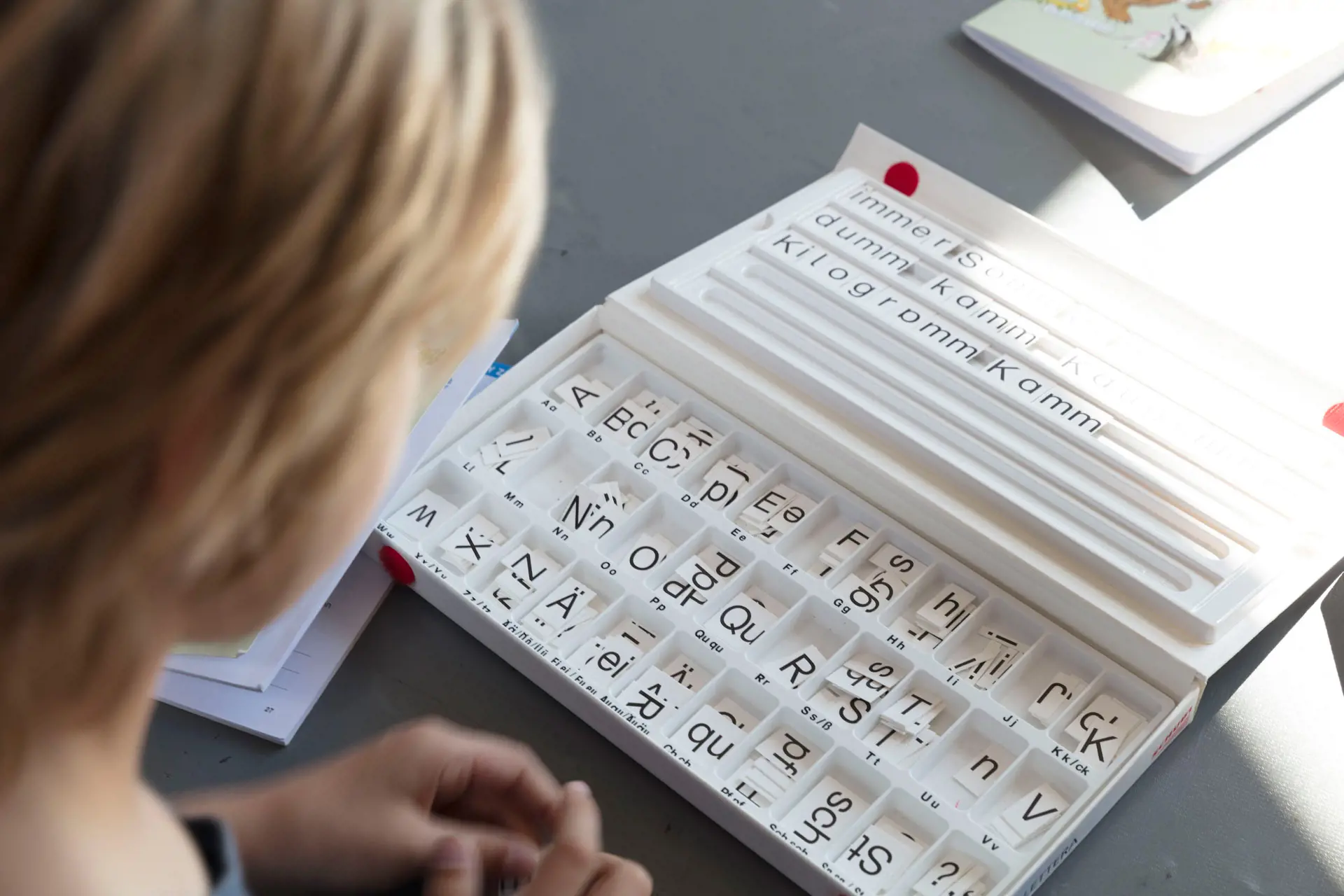
At PH Zurich, German language education is characterised by the following topics:
- Modelling linguistic skills in all areas of learning
- Exploration of the developmental and socialising processes of language acquisition, language learning and language reflection: focus on (linguistic and cultural) heterogeneity and the central role of (school) language skills for learning and social participation
- German as the language of education and instruction in all subjects
- The expanded concept of text in the (digital) media context and a concept of text that is based not only on written language and includes correspondingly structured, conceptually written and continuous texts, but also on everyday language characterised by conceptual orality and discontinuous formats.
- The establishment of the concept of “literacy”, which goes beyond the narrower concept of (functional) writing ability and includes questions of literary socialisation (developing attitudes towards writing, practices of writing) and the analysis of fictional texts.
These topics are being worked on and advanced by the German Language Education Research Group at PH Zurich.
Research focuses
Oral and written skills are the cornerstone of participation in literate societies, so it is important to understand the processes of acquiring and promoting such skills. German Language Education at the PH Zurich contributes to this in various thematic focuses.
Orality/conceptual writing
A large part of school teaching consists of listening and speaking; in our professional and personal lives, too, listening, speaking and holding conversations are crucial skills. Thus, oral language is an important learning medium, but also a learning topic when it comes to German lessons. However, the spoken language students hear at school differs in many ways from the spoken language they hear in everyday life. At the same time, written language also changes in the course of their school years: at the beginning, it differs little from spoken everyday language except in its medium, but it also becomes conceptually (more) written over the course of their school years. The aim is for school pupils to acquire the skill to communicate appropriately on the spectrum between medial and conceptual orality and medial and conceptual literacy, depending on the situation at hand.
Reading and writing go hand in hand
In their own ways, reading and writing both require processes that are structurally similar. Low on the skills hierarchy, fluency in reading and writing provides automatic access to word and syntactic skills and vocabulary. Hierarchical processes help to establish local and global coherence, for example, by retrieving knowledge of text types, forming inferences and (re-)constructing overarching structures of meaning. Reading and writing are thus not only comparable, but can have a mutually beneficial influence on each other.
Language reflection
Language plays an important role in the everyday life of young people. They use standard language, dialect and other languages, and they observe how different formulations – including those from youth slang – function and what differences there are between languages. Research in linguistics and on subject-specific education has not yet dealt much with such language reflection outside of school. For teaching in the “Language(s) in focus” skill area, however, it is crucial to know more about this, especially in order to go beyond traditional grammar teaching. The focus on language reflection is intended to close some of the knowledge gaps.
Early-childhood-appropriate language education
Since neither nurseries nor pre-schools are familiar with subject teaching, the principle of integrating everyday language education/language support into early-childhood education is being discussed intensively. This involves, for example, the question of how language education is carried out in everyday situations and in contexts relevant to a child’s social milieu. For as in all language learning contexts, the question of how to assess linguistic skills must also be answered for young children. The emphasis here is on providing insights.
Language-related search queries by school pupils on the internet
For German lessons, the internet is a key research medium when it comes to linguistic questions, in addition to other resources. Students are no longer looking up language-related questions concerning the spelling or meaning of a word in a paper dictionary; they instead google it or consult an online dictionary. Within German language and media education, as well as lexicography, there are hardly any findings to date on how school pupils answer language-related questions with the help of the internet. Furthermore, there is a lack of studies in language education that examine the use of linguistic information such as lexicographic information in language-reflection tasks. One of PH Zurich’s research focuses is therefore the language-related search queries of school pupils on the internet.
Other projects
Publications
2025
Bleiker, Johanna and Christian Efing (2025)
Schreiben als Lernwerkzeug in allen Fächern.
Pädagogik 9: 24–25.
2024
Hodson, Julia, Christa Dürscheid and Gerard Adarve (2024) Förderung sprachbezogener Recherchekompetenzen. Implikationen aus einer Befragungsstudie.
Der Deutschunterricht, 76 (2): 85–91.
Ballmer, Sinja, Larissa Greber and Britta Juska-Bacher (2024) Wortschatzerwerb – Wortschatzdidaktik – Wortschatzarbeit: Ein Umsetzungsvorschlag von linguistischem und didaktischem Wissen in einem Deutschschweizer Kindergarten-Lehrmittel.
Zeitschrift für angewandte Linguistik 80: 1–33.
Böhnert, Katharina, and Julia Hodson (2024) Didaktische Anregungen zum Thema “Lieblingswörter” im sprachreflexiven, sprachenintegrativen Deutschunterricht.
In: Verbindungen II. Deutsch-ukrainische Germanistiken im weiteren Dialog, hrsg. von Maria Ivanytska, Olena Materynska und Björn Rothstein, 23–38. Heidelberg: Universitätsverlag Winter.
Furer, Yves and Maik Philipp (2024) How a Short Writing Course Affects Self-Regulated Writing: A Multi-Motivational and Cognitive Perspective.
Journal of College Reading and Learning 54 (4): 245–63.
Peyer, Ann (2024) “Sie haben nur darauf gewartet, bis endlich mal jemand nachfragt” – Lehrpersonen über mehrsprachige Schüler:innen.
In: Babylonia 1/24
Rickert, Alex (2024) Schreibleistungen am Ende der beruflichen Grundbildung – eine (korpus)linguistische Grundlagenuntersuchung zu Bildungssprache sowie narrativen und explikativen Vertextungsmustern.
Dissertation, Zürich: Universität Zürich.
Schneider, Hansjakob, Yvonne Tucholski and Gesine Magdeburg (2024) Aus- und Fortbildungsmöglichkeiten im Bereich Deutsch als Zweitsprache für (angehende) Lehrkräfte im Kanton Zürich.
In: Deutsch als Zweitsprache als Studienfach für Lehramtsstudierende, hrsg. v. Julia Ricart Brede, Diana Maak und Sibylle Draber, 19–38. Lausanne: Peter Lang.
2023
Bleiker, Johanna and Michael Obendrauf (2023) Wenn man es aufschreibt, muss es richtig sein! – Kooperatives Verschriftlichen im naturwissenschaftlichen Unterricht als Möglichkeit, sprachliches und fachliches Lernen zu verbinden – und zu untersuchen.
Zeitschrift für Grundschulforschung (ZfG), Nr. 16: 75–94.
Hodson, Julia (2023) Sprachbezogene Suchfragen von Schülerinnen und Schülern im Netz.
MiDU – Medien im Deutschunterricht, 5 (1): 1–13.
2022
Bleiker Johanna (2022) Normen beim kooperativen Schreiben im naturwissenschaftlichen Unterricht – eine empirische Rekonstruktion.
Zeitschrift für Angewandte Linguistik (ZfAL), Nr. 77: 189–219.
Peyer Ann (2022) Methodische Konzepte der Sprachreflexion im Unterricht.
In: Sprachreflexion und Grammatikunterricht. 2. überarbeitete und erweiterte Auflage, hrsg. von Hildegard Gornik und Iris Rautenberg, 339–366. Baltmannsweiler: Schneider Verlag Hohengehren (Deutschunterricht in Theorie und Praxis 6).
Peyer Ann and Beate Lütke (2022) Implizites und explizites Wissen im Grammatikunterricht (Erstsprachunterricht).
VALS/ASLA Bulletin 115: 49–72.
Philipp Maik (2022) Digitales Lesen – selbstregulative Prozessverbünde für den versierten Umgang mit digitalen Informationen.
Mitteilungen des Deutschen Germanistenverbandes 69 (4): 360–69.
Philipp Maik (2022) Selbstreguliertes Lernen mit dem Schreiben: Grundlagen und Perspektiven der metakognitiven Selbstregulation und der kognitiven Belastung.
In: LesenSchreibenLesen in der Sekundarstufe I: Einblicke in Theorie, Empirie und Praxis, hrsg. v. Christina Korenjak, Monika Raffelsberger-Raup und Elfriede Witschel, 41–61. Innsbruck: Studien Verlag.
Schneider Hansjakob, Dieter Isler and Claudia Schmellentin (2022) Das Forschungsnetzwerk Schulsprachdidaktik als Sozalisationsraum und Motor der Fach- und Personalentwicklung.
Beiträge zur Lehrerinnen- und Lehrerbildung 40 (1): 20–40.
2021
Bleiker Johanna (2021) Interdisziplinäre Zugänge zu Deutsch als Zweitsprache (DaZ) – Begründung und Annäherung an eine Standortbestimmung.
In: Deutsch als Zweitsprache: Inter- und transdisziplinäre Zugänge, hrsg. v. Inci Dirim und Anke Wegner, 19–34. Mehrsprachigkeit und Bildung 3. Leverkusen: Barbara Budrich.
Hodson Julia (2021) Wörterbuchnutzung zur Erschliessung der Bedeutung unbekannter Wörter beim Lesen: Medienvergleich und kognitive Prozesse.
Doktorarbeit. Pädagogische Hochschule Heidelberg.
Peyer Ann (2021) Erfahrungsbezogene Zugänge zu Sprachbewusstsein.
ide 45 (3): 28–37.
Philipp Maik (2021) Lesen – Schreiben – Lernen: Prozesse, Strategien und Prinzipien des generativen Lernens.
Weinheim: Beltz.
Philipp Maik (2021) Schreiben lernen, schreibend lernen: Prinzipien des Aufbaus und der Nutzung von Schreibkompetenz.
Wiesbaden: Springer VS.
Schneider Hansjakob (2021) Language aptitude in German as a school language and English as a foreign language in primary school.
In: Individual differences in early instructed language learning. The role of language aptitude, cognition, and motivation, herausgegeben von Raphael Berthele und Isabelle Udry, 5:179–95. Eurosla Studies. Berlin: Language Science Press.
Röthlisberger Martina, Hansjakob Schneider and Britta Juska-Bacher (2021) Lesen von Kindern mit Deutsch als Erst- und Zweitsprache – Wortschatz als limitierender Faktor.
Zeitschrift für Grundschulforschung.
Doctoral theses
iArgue – The Potential of AI for argumentative writing in secondary education
Doctoral thesis by: Mirjam Wolfangel
Topic: A study of the effects of using AI for idea generation in argumentative writing on secondary school students‘ writing motivation, writing self-efficacy, and text quality.
Funded by: PH Zurich
Supervisors: Cornelia Glaser (PH Heidelberg), Maik Philipp (PHZH)
Writing processes of high-achieving pupils in science lessons
Doctoral thesis by: Angela Brütsch
Topic: The KoSNaWi project examines collaborative writing by 5th grade pupils in science lessons. The dissertation project focuses in particular on high-achieving pupils. The aim is to investigate which linguistic and cognitive resources these pupils draw on during writing, how they use them and what influence this has on the quality of their texts.
In addition to the written products, the resulting writing discussions are evaluated qualitatively and conversationally. This is intended to reveal characteristics of the writing processes of high-achieving pupils and to derive didactic implications for the promotion of writing skills in science lessons.
Funded by: Swiss National Science Foundation (SNSF; as part of the KoSNaWi project)
Supervisors: Noah Bubenhofer (UZH), Johanna Bleiker (PHZH)
Process and product function of external representations during reading multiple documents for discourse syntheses
Doctoral thesis by: Aleksandra Opacic
Topic: In the context of the experiments planned as part of the WRITE project, in which students write either summaries or arguments (discourse syntheses) on the basis of three documents, this dissertation project examines external representations (e.g. annotations, notes, highlightings/underlines) more closely. External representations are used during the integration process to assure individual, external results, and they can also be used as intermediate products for writing one’s own text. The main aim of the dissertation project is to investigate how relevant information are selected from multiple documents, how intra- and intertextual relationships are established, how information from intermediate products (like notes on notepaper) are organised and subsequently linked in a meaningful way. Furthermore, it will be examined how the specific characteristics of external representations manifest themselves in the later discourse syntheses or final products.
Funded by: Swiss National Science Foundation (SNSF; as part of the WRITE project)
Supervisors: Andreas Lachner, Maik Philipp and Tobias Richter
The influence of the task model on integration processes
Doctoral thesis by: David Romero
Topic: The focus of the academic enquiry is on students writing discourse syntheses. As part of the Write project, students write an argumentative essay or a summary on the basis of three documents. In addition to the process data, which is recorded with the help of think-aloud protocols, the task model is also collected. Theoretically, it is modelled as the mental representation of the task and controls the behaviour when solving the task.
The aim of the dissertation project is to investigate how, firstly, the task influences the task model and, secondly, the students’ approach in addition to the intra- and intertextual integration processes. The project also aims to examine to what extent there is a connection between the task model and process data.
Funded by: Swiss National Science Foundation (SNSF; as part of the Write project)
Supervisors: Andreas Lachner, Maik Philipp, Tobias Richter
Kognitive Prozesse von Lehrpersonen bei der Textbeurteilung
Doctoral thesis by: Yves Furer
Topic: Assessing texts is a challenging and time-consuming process for teachers that is particularly prone to errors. If their assessment of a text is not accurate enough, there is a risk that the pupil behind it will not receive all the support and encouragement they need. Since individual characteristics such as intelligence and subject knowledge are only linked to accurate assessments to a limited extent, this dissertation project focuses on the assessment process itself.
PH Zurich students were asked to assess a range of texts and eye tracking was used to record how long they spent looking at certain elements of the texts. The results revealed that errors were most likely to be identified quickly and influence the assessment. Students clearly had difficulties identifying issues such as lack of flow and poor vocabulary choice, however. This raises the question of how students can be trained to recognise more complex elements of texts with a view to minimising potential problems with assessments in their future working lives.
Supervisors: Anna-Katharina Praetorius, Peter Gerjets
Cooperation initiatives
The pedagogic-empirical writing research group (dieS)
This association of researchers from Germany, Austria and Switzerland cultivates interdisciplinary academic knowledge exchange on questions of researching and promoting writing and textual skills. dieS organises annual conferences and doctoral summer schools, and offers information and contact opportunities for interested parties via its website.
Within the scope of dieS, current research trends are incorporated and discussed, or new ones are developed and research findings are exchanged in the interest of further advancing pedagogic research into writing. One of the key aims is to advise doctoral students within the context of summer schools. Maik Philipp from the German Language Education Research Group is member of dieS.
The annual conferences are financed by the respective institutions hosting them. At PH Zurich, for example, funds were acquired from the SNSF and federal grants were used for PgB projects.
DFG Research Group “Sustainable Learning: Cognitive Mechanisms and Effective Implementation in the Classroom”
Little research has been carried out to date on sustainable learning processes in schools. An interdisciplinary research group is looking at this more closely in nine research projects, including in German as a subject.
The research group combines different approaches of learning theory, such as desirable difficulties and generative learning, to determine how learning leads to measurable improvements over time. PH Zurich’s Maik Philipp is a cooperation partner.
The Pedagogy of School Language Research Network (nets21)
The Pedagogy of School Language Research Network is a network of empirical researchers from the fields of German language education and related disciplines (e.g. German linguistics, educational psychology). PH Zurich’s Johanna Bleiker is member of nets21.
The network pursues the following goals:
- Knowledge exchange concerning research in the field of language and school
- Supporting junior researchers at the master’s, doctoral and post-doctoral qualification levels
- Exchange with other subject-specific pedagogies within the framework of interdisciplinary pedagogy
The network is being funded by contributions from the Swiss Confederation (PgB) from 2017 until the end of 2024.
Other activities
Symposion Deutschdidaktik (Symposium on German Language Education), Verein Fachdidaktik Deutsch (Association for German Language Education)
Various members of the German Language Education Research Group (Johanna Bleiker, Maik Philipp, Ann Peyer and Yves Furer) hold leading roles in these two professional associations.