Arts education
Auch auf Deutsch verfügbar
Content of this page
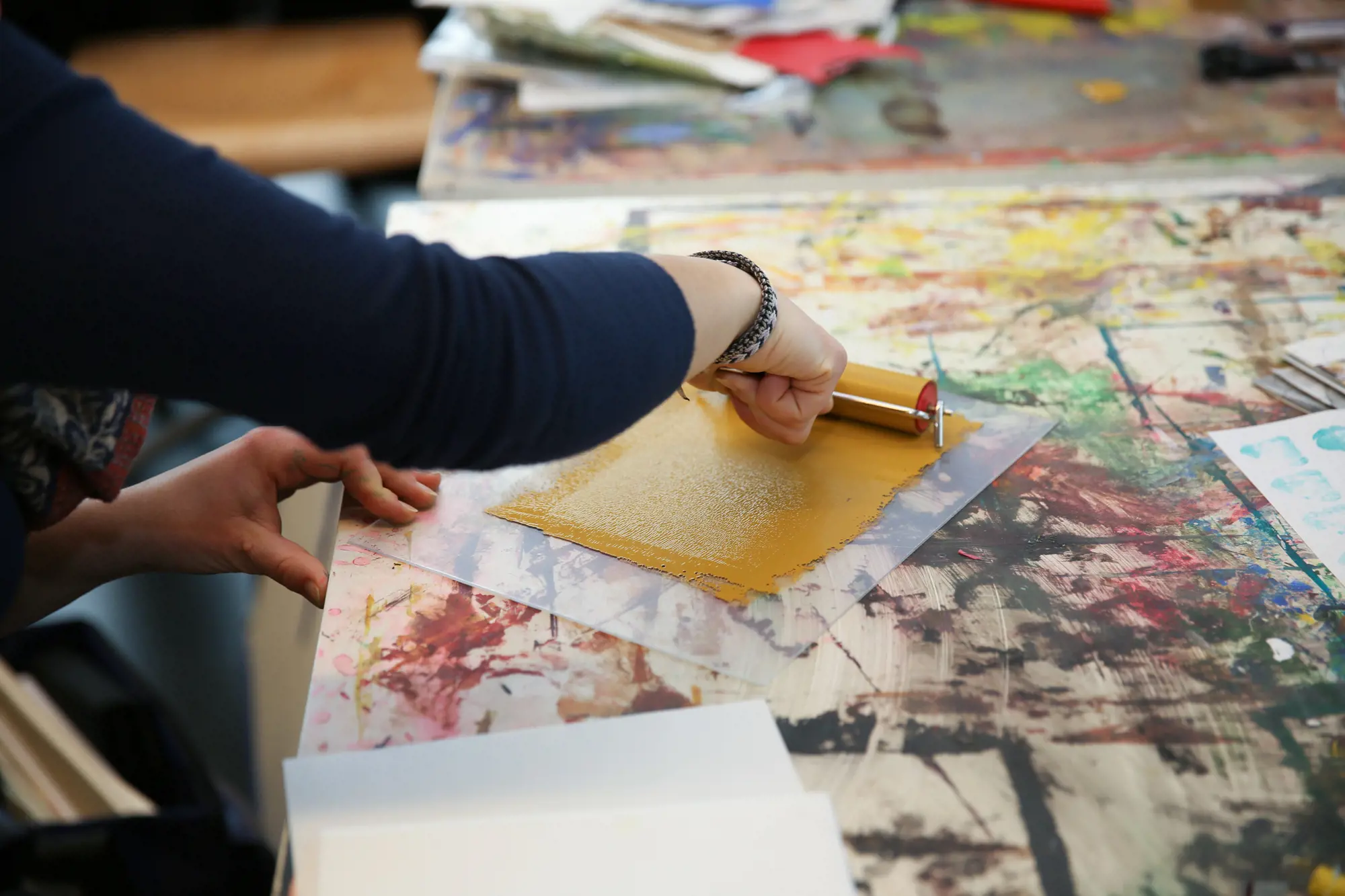
The arts education field of research addresses various disciplines: dance/rhythm/theatre education, music education, design and technology education and visual arts education.
A number of projects are ongoing or have recently been completed. These include research projects and doctoral theses.
Research focuses
Research and development relating to arts education is in the process of being set up. The various research and development projects have not yet been assigned to research focuses. They do, however, vary widely, suggesting the different directions in which the research interests and requirements might go.
An image gallery with 11 images follows.


Publications
2025
Bader, Nadia (2025) Bildsituationen und ihre Praktiken. Suchen, Auswählen und Herstellen von Beispielhaftigkeit in kunstpädagogischer Forschung und Lehre.
In: Bildsituationen, hrsg. von Jasmin Böschen, Andrea Sabisch, Lukas Sonnemann und Anna Stolz, 227–243. München: Kopaed.
Göksel, Eva and Marcel Felder (2025) Performativ orientierte Lehr-Lernmethoden in verschiedenen Unterrichtsfächern: Ein Erfahrungsbericht.
In: Scenario, Vol./Jg. 19, Issue/Ausgabe 1, S. 139–160.
Ivanova-Chessex, Oxana and Anja Morawietz (2025) (Ent)auratisierungen – Videographische Analysen zur Materialität des Bildes in der Kunstrezeption der ersten Schuljahre.
In: Collaeb contributions, 1–18.
Ivanova-Chessex, Oxana and Anja Morawietz (2025) Kinder als Subjekte der Bildrezeption? Empirische Erkundungen in schulischen und musealen Kontexten.
In: ZISU Zeitschrift für interpretative Schul- und Unterrichtsforschung, 14. Jahrgang.
Rhiner, Annette and Nadia Bader (2025) Adressierungen im Kunstunterricht: Alles eine Frage der Perspektive?
In: Unterrichtsvideos in der Schweizer Lehrpersonenbildung, hrsg. von Kerstin Bäuerlein, Sophia Bietenhard, Caroline Conk, Marco Longhitano und Sara Mahler, 129–139. Bern: Hep-Verlag.
2024
Bader, Nadia and Miriam Schmidt-Wetzel (2024) Wirksamer Kunstunterricht.
Baltmannsweiler: Schneider Verlag Hohengehren.
Bader, Nadia, Sina Hartmann, Notburga Karl and Raphael Spielmann (2024) “Kein Bock mehr auf Zoom!” oder: Vom Spiel mit den Regeln als Bildungschance.
In: Auf der Suche nach der fünften Dimension – Kollaboration und Digitalität in der Kunstpädagogik, hrsg. von Christin Lübke und Miriam Schmidt-Wetzel, 75–97. Bielefeld: Transcript Verlag.
2023
Bader, Nadia, Stefanie Johns and Lennart Krauss (Hrsg.) (2023) How to Arts Education Research? Wissenspraxen zwischen Kunst und Bildung.
München: Kopaed.
Lieber, Gabriele, Anja Morawietz, Sabine Richter and Bettina Uhlig (2023) Kunst auf Augenhöhe.
Villingen-Schwenningen: Neckar-Verlag.
2022
Aebersold, Ursula, Monica Bazzigher-Weder, Susanne Junger and Claudia Niederberger (2022)
Kunst & Bild: Bildnerisches Gestalten Im Zyklus 2 und 3.
Bern: Hep.
Doctoral theses
Investigation of the professionalisation processes of career starters in teaching songs to 4- to 6-year-old children
Doctoral thesis by: Ana Camiña Montero
Topic: When starting a career, professionalisation processes take place that are individual in nature, as coping with professional demands is subjective. This study focuses on teaching songs to children aged 4 to 6 years within the framework of music education. The aim of this dissertation is to explore the practice of teaching songs and the subjective interpretation and coping with requirements in order to reconstruct professionalisation processes.
Supervisor: Kai Niebert (Zurich University), Manuela Keller-Schneider (PHZH)
Processes of learning based on dialogue, aesthetics and research when creating a single item
Doctoral thesis by: Claudia Mörgeli
Topic: This research project aims to describe and analyse the processes of learning based on dialogue, aesthetics and research when pupils are creating a single item for “Textiles, Design and Technology” at primary school.
Observations focus on which verbal and gesture-based dialogues lead to questions of pupils’ skills as part of a teaching/learning arrangement based heavily on self-guidance and self-direction and how these dialogues can be used to guide further actions and processes.
Supervisor: Magdalena Eckes (University of Siegen/State Academy of Fine Arts in Stuttgart)
Introducing design processes to music lessons. Developing skills in new primary school teachers
Doctoral thesis by: Bernhard Suter
Topic: This design-based research study looks into teachers developing subject-specific teaching skills when using musical design processes in their lessons. The aim is to create tools for self-reflection that can help improve the professionalisation of teaching staff in relation to specific subject matter.
Supervisor: Isolde Malmberg (University of Potsdam)
Singing in a choir. Analytical description of learning and rehearsal processes when learning a new polyphonic song
Doctoral thesis by: Elsbeth Thürig-Hofstetter
Topic: In this study, the learning and rehearsal processes of amateur choir singers and the application of various learning strategies when learning a new polyphonic song are systematically observed and described. Video recordings are used to reconstruct proceedings in chronological order. Software (Melodyne) is used to analyse the vocal contributions of individual singers using a microprocessor. In a guided video-stimulated recall interview, the singers also describe how they applied learning strategies during choir practice – themselves, as a group or on the instruction of the conductor.
Supervisor: Isolde Malmberg (University of Potsdam)
Drawing as an educational opportunity in kindergarten
Doctoral thesis by: Anja Morawietz
Topic: Drawing with the intention of representation has the potential to promote emotional and cognitive development in young children. This is demonstrated by the author, who observed 5- to 6-year-olds drawing with the intention of representation over several weeks. The children experience cows on the farm, which they then capture in their drawings. They incorporate personal perspectives into their drawings and struggle to find their own visual solutions.
The children’s drawing processes are supported by teachers and videotaped. The exploratory data analysis, which uses sensitive coding to conduct a detailed analysis of selected sequences, reveals how the drawing activities slowly unfold. This provides new and surprising insights for research into children’s drawing. In many cases, the children engage in longer processes with pleasure and perseverance. The study makes it clear that development in children’s drawing does not simply result continuously from the child, but that the social resonance space plays an essential role. For some children, reassurance of closeness and friendship is important during the effort of drawing. For other children, mimesis and mimicry serve as a springboard for their own image ideas. And last but not least, collaboration in the form of dialogue, suggestions, questions and associations helps many drawings to progress.
In the last part of the book, the author uses the meaningful findings to derive suggestions for art education practice in nursery schools and the early years of school.
Drawing – Talking – Showing. Interactions between teaching-learning dialogues and creative processes in art lessons
Doctoral thesis by: Nadia Bader
Topic: The study begins with the question of how communicative exchange in art lessons influences artistic thinking and action. Using video data, four micro-case studies examine exemplary teaching and learning situations from multiple perspectives. The empirical findings form the basis for theory formation against the backdrop of practice-theoretical concepts linked to art and theatre education positions. The result is, on the one hand, a set of tools for the systematic description and analysis of teaching and learning processes in the form of a four-perspective model and, on the other hand, the further development of forms of visual representation and communication of research results, thus contributing to the repertoire of methods used in videographic research.
The study, which is designed as basic research, is dedicated to teaching practice in its contingency and complexity. The thesis is that a critical examination of what is supposedly self-evident and everyday in the sense of “regular practice” can become a fruitful starting point for reflection and innovation in subject didactics.
Supervisor: Andrea Sabisch (Hamburg University), Barbara Bader (former State Academy of Fine Arts in Stuttgart)
People
Network
Arts Education at the PH Zurich is networked with various local, national and international partners, committees and associations:
- Teaching Methodology for Arts (in German)
- Doctoral Programme in Subject-Specific Education and Teaching in the Arts
- Master’s degree in Textile and Technical Design – Design, PH Bern (in German)
- Expert Group on Intersectionality (Subgroup Science and Social Sciences Education Expert Group), PH Zurich
- Working Group on Design and Technology, Swiss Society for Teacher Education (in German)
- Working Group on Art and Images, Swiss Society for Teacher Education (in German)
- Swiss Association for Art Education (in German)
- Scientific Society for Art, Media, Education, Germany (in German)
- Association of Swiss Teachers of Visual Arts, Art and Design (in German)
- Design Committee, Swiss Teachers’ Association (in German)
- The International Society for Education Through Art