Teaching quality
Auch auf Deutsch verfügbar
Content of this page
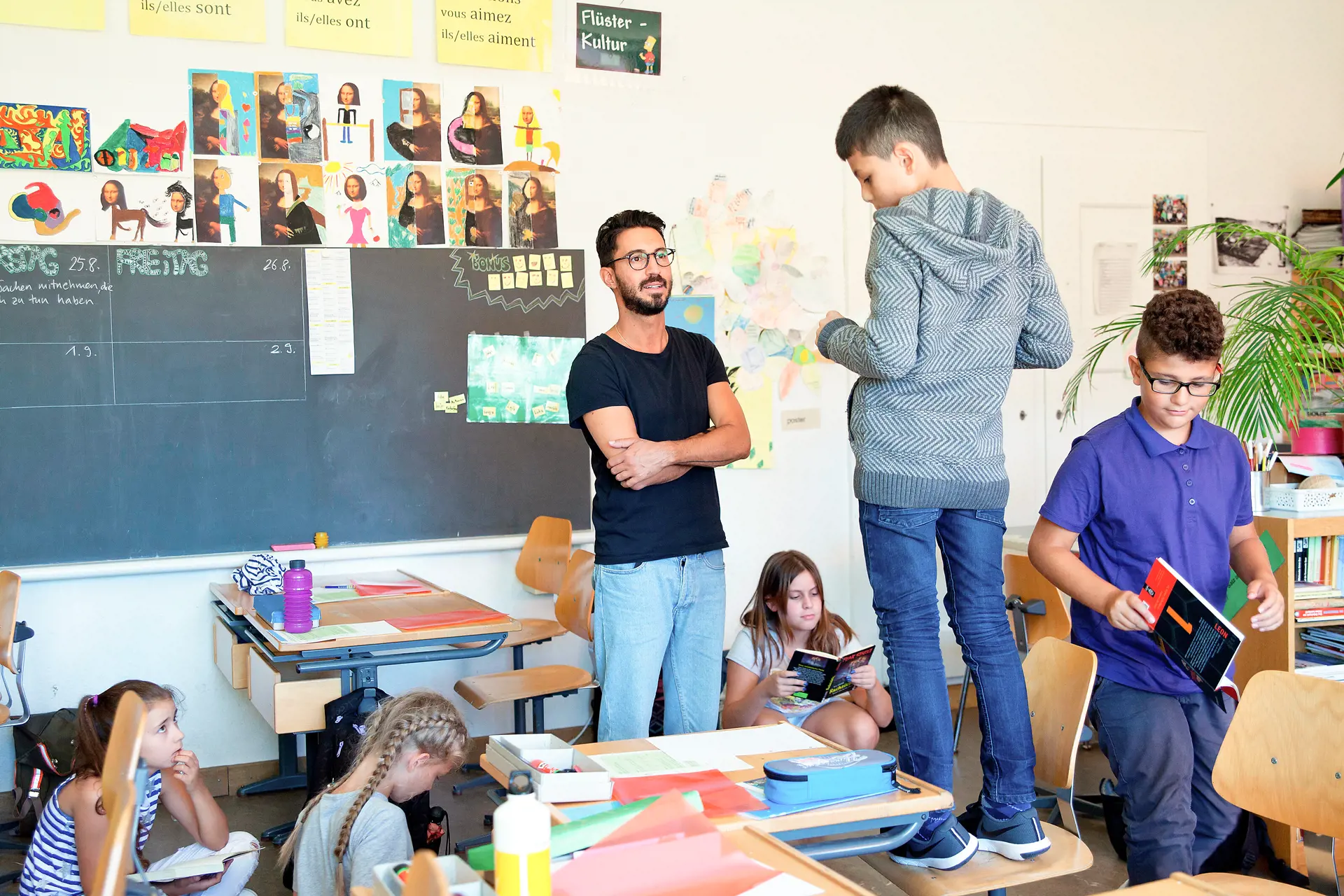
The question of what constitutes good and effective teaching is at the heart of research on education sciences and subject-specific education, and is a key learning objective of teacher training and continuing education. For many years, empirical teaching research has been discussing what constitutes good teaching and which dimensions can be used to describe it. In this context, mostly generic dimensions of teaching quality are considered, whereby the specifics of the different subjects or the different learning topics are often not taken into account.
What constitutes teaching quality in very central dimensions, however, depends directly on the specific learning topics or learning content. Thus, a model of teaching quality is needed that encompasses basic dimensions across subjects, but can be differentiated according to learning topics.
Research focuses
The key objective is to consistently focus the quality of teaching on subject-related learning topics. Based on the respective subject-related learning topics, specific teaching and learning processes are to be described and dimensions for sound subject teaching derived from them. The aim is to identify substantial differences and commonalities and to develop an interdisciplinary framework model of teaching quality that can be adapted for subject-related learning topics. Building on the model, an online-based formative evaluation tool will be developed. This will be carried out with a view to its applicability in the training and continuing education of teachers, for example in the context of discussions on teaching quality.
In order to achieve these goals, subject experts from various disciplines of training, continuing education and research are working closely together.
Publications
2025
Dubach, Josua, Sofia Anzeneder, Sebastian Tempelmann and Trix Cacchione (2025) Effects of School-Based Immersive Virtual Reality Interventions on Learning in the K-6 Range: A Systematic Literature Review.
Computers & Education: X Reality 7: 100117.
Keller, Stefan Daniel, Ursina Markwalder, Tino Endres and Anna-Katharina Praetorius (2025) Die Unterstützung des Konsolidierens – eine zentrale, aber vernachlässigte Dimension von Unterrichtsqualität.
Unterrichtswissenschaft 53: 153–99.
Lohmann, Julian Franz, Flavio Lötscher, Fynn Junge, Stefan Daniel Keller, Thorben Jansen, Johanna Fleckenstein and Jens Möller (2025) Testing Teacher Judgments Comprehensively: Accuracy, Halo, Frame of Reference, Strategy, and Personality Effects in Holistic and Analytic Assessments of Student Essays.
Journal of Educational Psychology, Advance online publication.
Lötscher, Flavio, Ruth Trüb, Julian Lohmann, Jens Möller, Thorben Jansen and Stefan Daniel Keller (2025) Development of Grammatical and Lexical Skills in Argumentative EFL Writing at Upper Secondary Level in Germany and Switzerland.
Frontiers in Education 10: 1605658.
Praetorius, Anna-Katharina, Armin Jentsch, Jennifer Luoto, Stefan D. Keller and Benjamin Fauth (2025) Context in Research on Teaching Quality: Bringing a Complex Idea into the Spotlight.
School Effectiveness and School Improvement 36(2): 263–96.
Trüb, Ruth, Jens Möller, Julian Lohmann, Thorben Jansen and Stefan D. Keller (2025) Judgment Accuracy in Primary School EFL Writing Assessment: Do Text Characteristics Matter?
Assessing Writing 66: 100957.
2024 and earlier
Fleckenstein, Johanna, Thorben Jansen, Jennifer Meyer, Ruth Trüb, Emily Raubach and Stefan Keller (2024) How am I going? Behavioral engagement mediates the effect of individual feedback on writing performance
Learning and Instruction 93: 1–10.
Begrich, Lukas, Anna-Katharina Praetorius, Jasmin Decristan, Benjamin Fauth, Richard Göllner, Christian Herrmann, Marc Kleinknecht, Sandy Taut and Mareike Kunter (2023) Was tun? Perspektiven für eine Unterrichtsqualitätsforschung der Zukunft
Unterrichtswissenschaft 51 (1): 63–97.
Praetorius, Anna-Katharina, Charalambos Charalambous, Wida Wemmer-Rogh, Leonie Gossner, Christian Herrmann, Stefan Ufer, Cornelia Gräsel, Stefan Keller (2023) MAIN-Teach-Modell
Keller Stefan, Ruth Trüb, Emily Raubach, Jennifer Meyer, Thorben Jansen und Johanna Fleckenstein (2023) Designing and validating an assessment rubric for writing emails in English as a foreign language.
Research in Subject-matter Teaching and Learning (Ristal), 6(1), 16–48.
Herrmann Christian (2021) Unterrichtsdimensionen und -merkmale als Orientierungspunkte eines wirksamen Sportunterrichts
In: P. Neumann & E. Balz (Hrsg.), Wirksamer Sportunterricht (Unterrichtspraxis: Perspektiven von Expertinnen und Experten, Bd. 17, 1. Auflage, S. 49–59). Baltmannsweiler: Schneider Hohengehren.
Praetorius Anna-Katharina, Christian Herrmann, Erin Gerlach, Meik Zülsdorf-Kersting, Benjamin Heinitz und Andreas Nehring (2020) Unterrichtsqualität in den Fachdidaktiken im deutschsprachigen Raum – zwischen Generik und Fachspezifik
Unterrichtswissenschaft, 48(3), 409–446.
Doctoral theses
Describing and recording the quality of foreign language teaching at primary level from a generic and subject-specific perspective
Doctoral thesis by: Angela Schlatter
Topic: The dissertation project addresses the need for research that brings together findings from investigations into second language acquisition, subject-specific education and education sciences. It works at the interface between research and training by developing and testing a teaching quality model and a corresponding observation tool for foreign language teaching. This tool is intended to help students of primary school education to plan and reflect on their lessons in order to design teaching that results in effective learning.
Funded by: PH Zurich
Supervisors: Stefan Daniel Keller (PHZH) and Anna-Katharina Praetorius (UZH)
Training Assessment Competences in English as a Second Language (TrACE)
Doctoral thesis by: Flavio Lötscher
Topic: The research team is investigating whether visualisation of certain text features, such as spelling mistakes or arguments and counterarguments, leads to more nuanced perception and whether it enables prospective teachers to assess English essays more objectively and accurately. The results contribute to the development of an online training tool that will support both the training of English teachers and the learning of pupils.
Funded by: Swiss National Science Foundation (SNSF), German Research Foundation (DFG)
Supervisor: Stefan Daniel Keller (PHZH), Yves Karlen (UZH), Jens Möller (CAU)
Discussion forum
The discussion forum’s aim is to shed light on the different facets of teaching quality. To this end, speakers who have dealt with the topic in an extraordinary way are regularly invited, with the intention of promoting exchange between different people within and outside of PHZH and to foster networking among all participants.
Previous events and presentations
Discussion forum on 29 February 2024: “Various facets of teaching quality – experiences from international education work”
Guest speaker: Professor Wiltrud Weidinger and Professor Rudolf Isler
In their lecture, Wiltrud Weidinger and Ruedi Isler linked different quality features of teaching with the needs of educational institutions in Ghana, Bahrain, Moldova, Georgia and Armenia. The projects resulted in a learning model and fundamental content that was discussed for teacher education. In addition, the audience gained insight into development work and transcultural experiences.
Presentation by Wiltrud Weidinger and Rudolf Isler (in German)
Discussion forum on 17 January 2024: “Measuring teachers’ perception of inclusive (mathematics) teaching”
Guest speaker: Professor Gabriele Kaiser, University of Hamburg and Nord University
As part of the TEDS-IME project, a professionalisation measure for teaching and learning algebra in lower secondary education was developed that integrates both mathematics education and general pedagogical perspectives. The measure was/is being implemented in Hamburg and North Rhine-Westphalia from February 2023 to February 2024 in cooperation with universities, schools and institutes for teacher education and training. To evaluate the professionalisation measures in a pre-post design, a video-based tool was developed to measure the professional perception of teaching by (future) teachers, focusing on inclusive teaching and relevant knowledge tests for pedagogical and mathematics education inclusion-related knowledge. Professor Kaiser presented the tool for the professional perception of teaching, the conception of the professionalisation measure and the first results of the implementation of the professionalisation concept.
Discussion forum on 17 November 2023: “Modules on teaching quality at PHZH – insights and exchange”
Speakers: Sandro Biaggi, Simone Herzog, Karin Landert Born, Stefan Marty, Silvia Menzi, Theresia Müller, Hanna Weinmann, Barbara Zumsteg
Lecturers from the PHZH’s early primary, primary and lower secondary levels provided insights into the curricula of the level-specific module ‘Teaching Quality,’ which students complete as part of their training. Emphasis was placed on the theories and models of teaching quality imparted in the modules and the analysis of videotapes of their own and third-party teaching with regard to selected characteristics of teaching quality. In the subsequent inspiring discussion about the similarities and differences in the modules, experiences were exchanged, challenges were discussed and potential for future collaboration was identified.
After consultation with the speakers, the event’s minutes and the presentations can be requested from
Discussion forum on 29 August 2023: “Opportunities and challenges of teaching assessment with INSULA”
Guest speaker: Wida Wemmer-Rogh, Chair for Research on Learning, Instruction, and Didactics at the University of Zurich
In her presentation, Wida Wemmer-Rogh presented the INSULA instrument, which was developed and validated at the University of Zurich, for the observation-based assessment of teaching quality as part of external school evaluations in German-speaking Switzerland. She explained its development background and presented the results of the evidence-based validation of INSULA. Finally, the opportunities and challenges of teaching assessment with INSULA were discussed.
Discussion forum on 27 April 2023: “On the path from teaching research to teaching development – lesson observation and feedback”
Guest speaker: Professor Benjamin Fauth, Institute for Educational Analysis Baden-Württemberg (IBBW)
In his lecture, Professor Benjamin Fauth dealt with the fundamental dimensions of teaching quality. Teaching quality is a decisive factor in the learning success of pupils, with the underlying structure playing a decisive role. Overall, Professor Fauth clarified that teaching quality is a complex construct that must be considered on different levels. Successful lesson design requires a deeper understanding of the underlying teaching structures and a balanced consideration of the different fundamental dimensions of teaching quality. In this context, he presented a specific assessment tool that is intended to make teaching quality observable in concrete terms, thus bridging the gap between teaching research and teaching development.