Vocational education
Auch auf Deutsch verfügbar
Content of this page
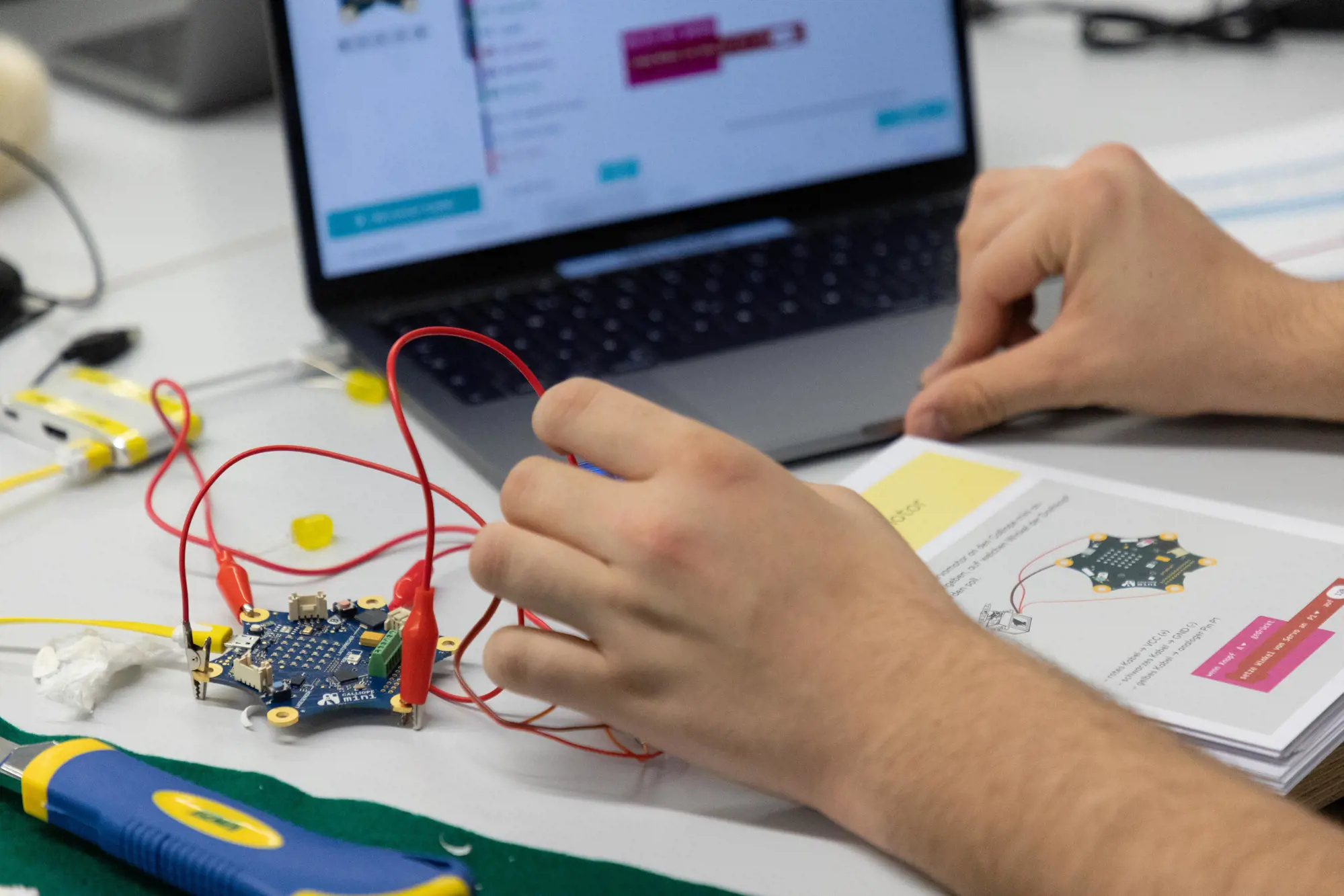
Research activities in the field of vocational education are characterised by theoretical and methodological references to various sub-disciplines of education sciences, interdisciplinary approaches and by the transfer of research findings into practice (e.g. academic supervision, consulting, evaluations, training and continuing education of vocational school teachers).
Research focuses
The vocational school as a place of learning – in cooperation with other places of learning – makes a significant contribution to the development of vocational skills among apprentices. In the individual projects, didactic concepts and practices for vocational training and general education are investigated, e.g. curricular skills concepts (competencies, transversal skills) and skills-oriented teaching/learning arrangements.
Professional skills of vocational high school teachers in training
The connection between professional knowledge and skills and thus the link between pedagogical-didactic and vocational training is central to teacher training. Different aspects of effective and reflective professional skills of vocational high school teachers in training are examined in individual projects. Examples include professional expertise in educational technology, analytical and reflective skills relating to subject-specific education, assessment skills and professional skills relating to diversity and inclusion.
Diversity and inclusion in vocational education
Migration and inclusion are key factors that have an influence on how vocational education is delivered. Successful vocational integration and student participation depends on targeted subject-specific support for key qualifications and careful consideration of individual educational requirements based on past experience, such as special educational needs, impairments or learning difficulties. To that end, support requirements, educational opportunities, additional assistance and professional skills are compared on both a national and international scale.
Vocational education for adults
Adults achieving qualifications later in life is hugely significant from a social and economic perspective. In Switzerland, a considerable proportion of people aged between 25 and 64 do not have any qualifications at upper secondary level and are not sufficiently integrated into the job market as a result. Meanwhile, there is huge demand for people with qualifications in light of the current shortage of skilled workers. Research into this topic at PH Zurich relates to the challenges associated with the current routes (such as the validation process and direct admission for final examinations) and the different ways in which cantons, associations and education providers attempt to overcome these challenges.
Vocational education in developing countries
In light of the high quota of youth unemployment in many developing countries, supporting vocational education has become a key concern in international cooperation. This research focus examines processes for vocational qualifications in different industries and experience of transferring the dual model of vocational education and implementing procedures for recognising qualifications.
Publications
2024
Ackermann, Nicole, and Monika Albrecht (2024) Nachhaltigkeit als normatives und regulatives Leitbild für eine humane Ökonomie.
In: Humane Ökonomie – selbstverständlicher Auftrag sozioökonomischer Bildung und Wissenschaft oder sozialromantische Utopie?, hrsg. von Georg Tafner, Nicole Ackermann, Udo Hagedorn und Cornelia Wagner-Herrbach, 271–89. Leverkusen: Verlag Barbara Budrich.
Ackermann, Nicole (2024) On the Educational Ideal of the Economic Citizen: A Competence Model for Economic Education and a Domain Analysis of the Societal Life Sphere.
In: Society and Politics, hrsg. von Udo Hagedorn, Reinhold Hedtke, Philipp Mittnik und Georg Tafner, 133–62. Wiesbaden: Springer.
Maurer, Markus (2024) Zur Entwicklung und Umsetzung von Anerkennungsverfahren in der Berufsbildung: Vergleichende Analysen von Fallstudien aus historisch-institutionalistischer Perspektive.
Habilitation, Zürich: Universität Zürich.
Tafner, Georg, Nicole Ackermann, Udo Hagedorn und Cornelia Wagner-Herrbach (2024) Humane Ökonomie – selbstverständlicher Auftrag sozioökonomischer Bildung und Wissenschaft oder sozialromantische Utopie.
Leverkusen: Verlag Barbara Budrich.
Weil, Markus (2024) Weiterbildung als “Flexibilisierungsoption” für die Lehrerinnen- und Lehrerbildung an Pädagogischen Hochschulen.
Beiträge zur Lehrerinnen- und Lehrerbildung 42 (2): 147–64.
2023
Pfiffner, Manfred, Saskia Sterel and Martin Berger (2023) Kooperation. Gemeinsam (Lern-)Erfolge erzielen.
Bern: Hep-Verlag.
Ackermann, Nicole and Simone Heinecke (2023) Was lernen zukünftige Kaufleute? Eine qualitative Analyse des neuen Lehrplans für die kaufmännischen Berufsschulen in der Schweiz.
In: Die Förderung von transversalen Kompetenzen in der Berufsbildung, hrsg. v. Antje Barabasch und Silke Fischer. bwp@ Berufs- und Wirtschaftspädagogik – online, bwp@ Spezial 20 (11): 1–26.
Ackermann, Nicole and Simon Luger (2023) Welche Vorstellungen von Erziehungswissenschaft haben Studienanfänger:innen? Eine explorative Studie anhand wissenschaftlicher Arbeiten aus einer propädeutischen Lehrveranstaltung.
Die Hochschullehre 9 (5): 55–69.
Ackermann, Nicole and Thomas Ruoss (2023) Gymnasiale Lehrpläne in der multilingualen Schweiz: Eine fachdidaktische Analyse von Bildungszielen, überfachlichen und fachlichen Kompetenzen am Beispiel der ökonomischen Bildung.
Schweizerische Zeitschrift für Bildungswissenschaften 45 (3): 293–306.
Gutzwiller-Helfenfinger, Eveline, Susan Müller, Georg Berger and Manfred Pfiffner (2023) myidea entwickelt sich weiter. Transfer.
Berufsbildung in Forschung und Praxis 8 (13).
Kamm, Franziska and Reto Wegmüller (2023) Partizipation an Berufsfachschulen: Politische Bildung und die Einbindung in Entscheidungsprozesse von Lernenden und Mitarbeitenden.
#schuleverantworten 3 (2): 43–51.
Maurer, Markus (2023) Kooperation in der Berufsbildung für Erwachsene in der Schweiz: Ein Blick auf die Kantone.
EP (Education Permanente). Schweizerische Zeitschrift für Weiterbildung (2): 69–77.
Maurer, Markus (2023) The limits of reforming access to vocational qualifications: the slow expansion of recognition of prior learning (RPL) in Sweden and Switzerland.
Journal of Vocational Education and Training 75 (3): 543–63.
Maurer, M., F. A. Haolader and S. S. Shimu (2023) VET for all: Assessing the case of Bangladesh.
International Journal of Educational Development, 101.
Maurer, Markus and Ognen Spasovski (2023) Expanding the Validation of Prior Learning in the Context of European Integration: The Case of North Macedonia.
European Education 54 (3–4): 102–115.
Moser, Daniela, Nicole Kimmelmann, Susanne Miesera and Silvia Pool Maag (2023) Diversity-Oriented Teachers for Vocational Education. Analysis and Modelling of Competence Requirements for Teacher Education and Training.
Trends in Vocational Education and Training Research 6: 168–79.
Ruoss, Thomas, Nicole Ackermann and Talia Stadelmann (2023) Cultures of economic education: Grammar school curricula in a multilingual comparison.
European Educational Research Journal 22 (6): 781–97.
Ackermann, Nicole (2023) Ökonomische Bildung im Kontext gesellschaftlicher Transformation und gesellschaftlicher Partizipation: ein Plädoyer für die Revitalisierung eines wirtschaftspädagogischen Konzepts.
In: Berufs- und Wirtschaftspädagogik im selbstkritischen Diskurs, hrsg. von Klaus Beck und Jürgen Seifried, 65–83. Bielefeld: wbv Publikation.
Maurer, Markus (2023) Forschung zur Validierung im Bildungswesen: Aktueller Stand und Perspektiven.
In: Handbuch Validierung non-formal und informell erworbener Kompetenzen: Disziplinäre, theoretische und konzeptionelle Zugänge, hrsg. v. Martin Schmid, 71–86. Bielefeld: wbv Publikation.
Röhl, Tobias (2023) Doing Media. Zum Verhältnis von Materialität und Medialität aus praxistheoretischer Sicht.
In: Ethnographie und Videographie pädagogischer Praktiken: “Ein-Blicke” in Projekte der Schul- und Unterrichtsforschung in einer Kultur der Digitalität, hrsg. v. Mandy Schiefner-Rohs, Carina Heymann und Isabel Neto Carvalho, 56–67. Bad Heilbrunn: Klinkhardt.
Röhl, Tobias (2023) Mittendrin – der pädagogische ICT-Support an Zürcher Volksschulen und gemeinschaftliche Führung.
In: Digital Leadership – Schulen im digitalen Wandel führen, hrsg. v. Tobias Röhl, Johannes Breitschaft, Eliane Burri und Nicole Wespi, 140–49. Bern: Hep-Verlag.
Dernbach-Stolz, Stefanie (2023) Nationale Reformen in transnationalen Kontexten – Eine vergleichende Studie zur Berufsbildung in Finnland und der Schweiz aus der Perspektive des lebenslangen Lernens.
Dissertation. Universität Zürich.
Weil, Markus (2023) Systematic potentials for co-operation: UCE as a gateway for HE?
European Journal of University Lifelong Learning 7 (2): 81–88.