Psychology of learning and teaching
Auch auf Deutsch verfügbar
Content of this page
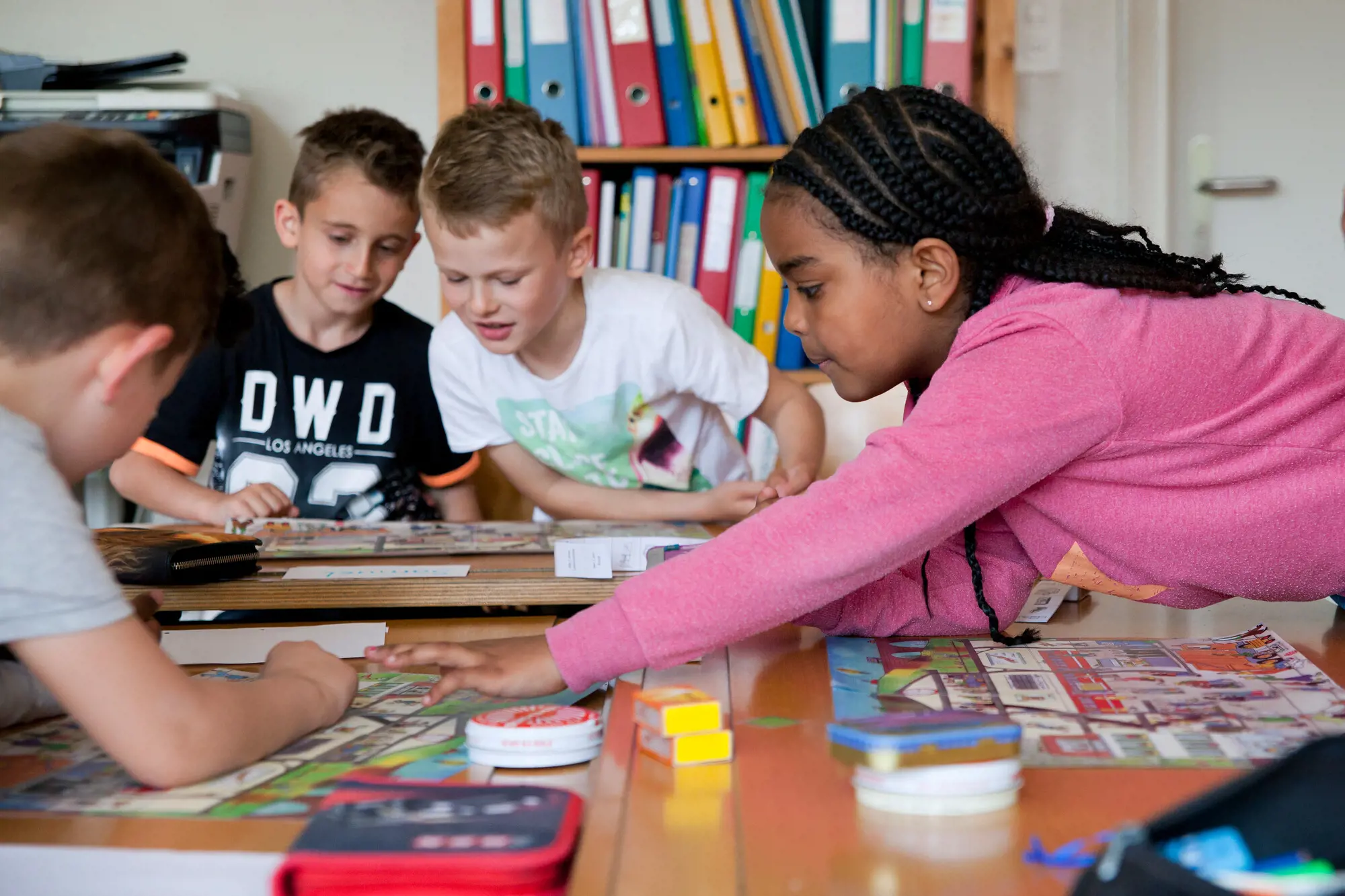
Children and adolescents learn and develop through a complex interplay of individual and contextual factors. Development contexts are characterised by rapid change – due to crises, migration or inequalities, for example. Protection processes and the development of resilience are of particular relevance. Belief in self-efficacy, self-regulation skills, socio-emotional competencies and playfulness are regarded as key individual resources for dealing with stress, pressure and insecurities. The quality of pedagogical interactions and social relationships serve as an additional resource at the social level.
These resources are also of great importance for teachers. In their profession, teachers are faced with diverse and complex demands. Their ability to handle stress is essential for their well-being and for the design of successful pedagogical interactions. For this, they need professional skills such as the ability to self-regulate.
Within the framework of the thematic focus, questions concerning the learning and development processes of children, adolescent and teachers are investigated. The focus is on skills, resources and protection processes for positive development. The interplay between teachers’ characteristics and behaviour, the characteristics of pedagogical interactions and the learning and development processes of pupils are of particular interest. Questions related to longitudinal development, interdisciplinary and professional competences, and the social interactions of children, adolescents and teachers will be addressed.
Research focuses
Dealing with stress and pressure in the teaching profession
This research topic focuses on questions about the emergence and management of stress in everyday working life; the interaction between engagement, stress and self-regulation; and promoting and supporting self-regulation skills among teachers and students. Of additional interest is the interaction between self-regulation and playfulness in teachers as a coping strategy in everyday teaching.
Playfulness and playful teaching
This research topic investigates the importance of playfulness for the learning and development processes of children and adolescents, and the links between teachers’ playfulness, their teaching behaviour and characteristics of the quality of interaction between teachers and pupils. A major focus is also the question of how teachers’ playfulness in the classroom can be used didactically to stimulate and support pupils’ learning and development.
Pedagogical interactions
High-quality pedagogical interactions are crucial for the cognitive and social-emotional development of children and adolescents. This research topic investigates the quality of pedagogical interactions from different perspectives – in longitudinal terms and in its impact on the learning and development of children and adolescents.
Publications
2025
Bieri Buschor, Christine, Simone Berweger, Zippora Bührer, Andrea Keck Frei, Christine Wolfgramm and Nicole Périsset (2025) Durch Coaching zielorientiert am Umgang mit Belastung dranbleiben – ein Programm zur Stärkung der Selbstregulation von Lehrpersonen.
In: Coaching und kollegiale Beratung, hrsg. v. Christine Bieri Buschor, Esther Forrer Kasteel und Wildtrud Weidinger, 267–85. Bern: Hep.
Bührer, Zippora, Christine Wolfgramm, Simone Berweger, Andrea Keck Frei and Christine Bieri Buschor (2025) Why coaching matters: exploring the interplay of teacher self-regulation and well-being with a longitudinal multigroup model.
Frontiers in Psychology 16: 1647838.
Duss, Isabelle, Cornelia Rüdisüli, Corina Wustmann Seiler and Patricia Lannen (2025) Fostering Playfulness in 2-to-6-Year-Old Children: A Longitudinal Study of Parental Play Support Profiles and Their Effects on Children’s Playfulness.
Behavioral Sciences 15(12): 1716.
2024
Duss, Isabelle; Rüdisüli, Cornelia; Wustmann Seiler, Corina and Lannen, Patricia (2024) Development of playfulness in children with low executive functions: The role of parental playfulness and parental playtime with their child.
Behavioral Sciences, 14 (7), 542.
Eckstein, Boris and Alexander Wettstein (2024) Zur Qualität pädagogischer Interaktionen im Unterricht. Eine neuartige theoretische Konzeptualisierung und eine innovative 2×3×2-Systematik.
Schweizerische Zeitschrift für Heilpädagogik 30 (3): 2–9.
Rüdisüli, Cornelia; Duss, Isabelle; Lannen, Patricia and Wustmann Seiler, Corina (2024) Relations between teacher–child interaction quality and children’s playfulness.
Early Child Development and Care 194 (7–8): 883–97.
Wustmann Seiler, Corina, Isabelle Duss, Cornelia Rüdisüli and Patricia Lannen (2024) Developmental trajectories of children’s playfulness in two- to six-year-olds.
Frontiers in Developmental Psychology 2: 1–18.
2023
Duss, Isabelle; Rüdisüli, Cornelia; Wustmann Seiler, Corina and Lannen, Patricia (2023) Playfulness from children’s perspectives: development and validation of the Children’s Playfulness Scale as a self-report instrument for children from 3 years of age.
Frontiers in Psychology, Section Developmental Psychology 14: 1–11.
Rüdisüli, Cornelia; Duss, Isabelle; Lannen, Patricia and Wustmann Seiler, Corina (2023) External assessment of teachers’ roles during children’s free play and its relation to types of children’s play.
Frontiers in Education, Section Educational Psychology 8: 1–13.
Sticca, Fabio, Olivia Gasser-Haas und Corina Wustmann Seiler (2023) The interplay among familial risk, narrative coherence, and emotional problems from early to middle childhood.
Frontiers in Psychology: Developmental Psychology 14: 969–74.
Doctoral theses
Playfulness in the context of professional-child interaction in daycare centres and kindergartens
Project name: Playfulness in the context of professional-child interaction in daycare centres and kindergartens
Doctoral thesis by: Cornelia Rüdisüli
Topic: Young children learn in and through play(s) and acquire specialised and interdisciplinary skills in the process. Playfulness refers to the ability, willingness and enjoyment of children to engage in play(s); it is also referred to as play quality. Little is known about what adults can contribute to the development of this quality of play. The dissertation focuses on the question of how professionals and teachers in day-care centres and kindergartens can support and strengthen the development of children’s quality of play through their pedagogical interactions.
Funded by: Swiss National Science Foundation (SNSF)
Supervisors: Anna-Katharina Praetorius and Corina Wustmann Seiler