Zurich Digitalisation Initiative : PH Zurich opens Immerse Lab
In PH Zurich’s newly opened Immerse Lab, experts from various disciplines come together to learn about immersive technologies for the education sector and explore their potential. The space offers the opportunity to test concepts and develop them into prototypes. Martin Berger, project manager at PH Zurich, outlines the opportunities in this interview.
Martin Berger, what is the aim of the Immerse project? What is the role of the three participating universities? Or to put it another way: which fields of knowledge converge here?
IMMERSE aims to promote the didactically sound use of new visual technologies, for example in the field of human-computer interaction. To this end, the three leading universities are pooling their strengths: the University of Zurich contributes its expertise in visual computing and artificial intelligence, ZHAW its technological development expertise and proximity to industry and PH Zurich its expertise in pedagogy and didactics. This synergy enables practical innovation. The mission of IMMERSE is to generate concrete ideas and establish an organisational structure that supports prototyping and promotes sustainable integration.
The Immerse Lab was recently put into operation at PH Zurich. What is the idea behind this space? What is happening there? And who is going to use it?
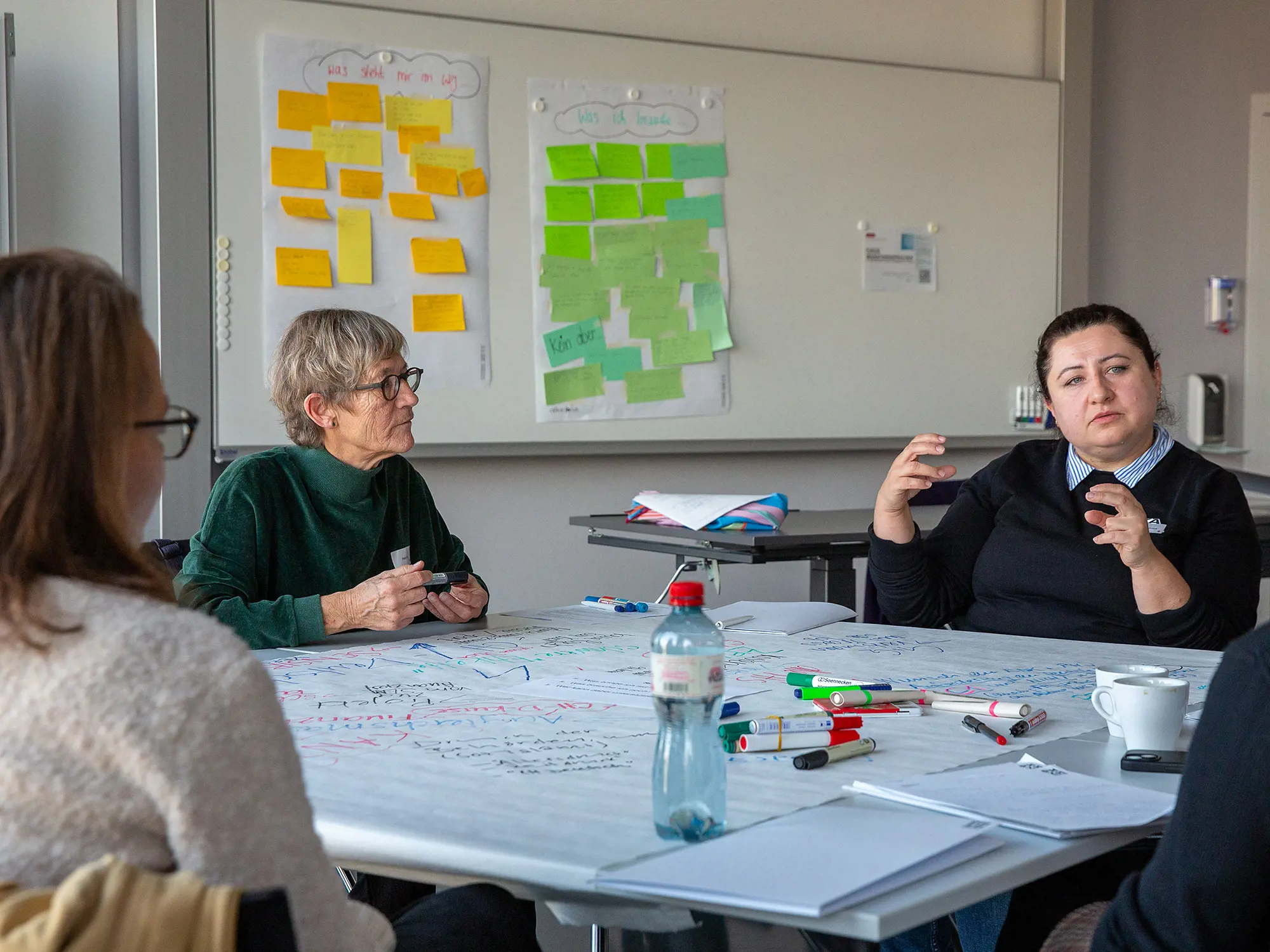
The Immerse Lab is available to anyone interested in vocational and higher education. It serves as a workshop for ideas, in which virtual technologies are discovered and tested, explored from an educational standpoint and developed into prototypes. For example, we bring together specialists from the fields of teaching and technology in a targeted manner in what are known as sandbox events. Two events on virtual communication in nursing education and co-embodiment in sports education have already taken place. At the end of October, a sandbox event on geo-immersion will take place, in which experts from Zurich’s universities, Baugewerbliche Berufsschule Zürich (Zurich Vocational School for Construction), Zurich’s Urban Planning Department, the DIZH project “Gestalte Zürich” (“Designing Zurich”) and technology partner AFCA will discuss scenarios for making urban spaces immersive.
Why is physical space important for virtual technology?
Physical space is crucial because learning is a social process. Physical space creates visibility, trust and the necessary social framework to enable innovation to diffuse into teaching. And what is particularly important to me as a professional educator is that the lab promotes physical encounters between stakeholders in vocational and higher education, which helps to link the two worlds more closely in the digital transformation and to exploit synergies. The planned Immerse Theatre, which is scheduled to open in summer 2026, adds another dimension: entire data spaces can be discovered as a shared, immersive learning experience.
What can immersive technologies achieve in education that analogue approaches cannot? Are there examples where immersive learning technologies are already being used successfully?
Immersive technologies enable learning spaces that are barely accessible by analogue means. They make it possible to practise risky activities in a safe way, visualise complex processes and run through tricky situations without pressure. Developments in the field of artificial intelligence offer many additional possibilities here. There are already numerous examples of use in vocational education, such as a learning app that we developed for prospective retailers. They use it to practise a challenging sales pitch with an AI customer who faces them as a life-size avatar in a real-world setting. Immersive technologies are designed to make learning more effective and enjoyable.
Digitalisation Initiative
The Digitalisation Initiative of the Zurich Higher Education Institutions (DIZH) aims to promote collaboration between Zurich universities in the area of digitalisation and thereby strengthen Zurich as a centre for research and business. The University of Zurich, Zurich University of Applied Sciences, Zurich University of the Arts and PH Zurich are systematically networking within the DIZH in order to promote research and innovation on digitalisation topics using interdisciplinary approaches.