PH Zurich Summer School
Content of this page
| Dates | 28 June to 9 July 2027 |
|---|---|
| Courses | Education in Times of Conflict |
| Gamification and Mindfulness | |
| Life Skills – Empowering Students to Learn, Grow and Thrive | |
| Body, Voice, Space | |
| Duration | 2-week programme, offering four topic combinations, including a 2-hour online session prior to the course start |
| Application | 1 November 2026 to 30 April 2027 |
| BIP Grant | Blended Intensive Programme (BIP) for students from our European partner universities within the SEMP programme, limited number of places. The grant (approximately CHF 400) will be paid out after arrival. |
| Fee in CHF | Nominated students from partner universities: 390 |
| Programme fee for students from other universities: 790 | |
| ECTS points | 2-week programme including online session: 5 ECTS |
| Additional individual assignment: 1–2½ ECTS | |
| Maximum 7½ ECTS |
Why choose PH Zürich Summer School
- Connect and exchange with international students from around the world.
- Explore innovative and timely issues in teacher education.
- Select from four topic combinations and earn up to 7½ ECTS.
- Study at PH Zurich – the largest university of teacher education in Switzerland.
- Enjoy a central campus location right next to Zurich’s main train station.
- Discover Zurich and Switzerland through a rich programme of social and cultural events.
An image gallery with 6 images follows.


Course programme 2027
The programme consists of four different courses that can be combined in four ways. All options consist of two weekly courses. An optional third week for an individual assignment is available.
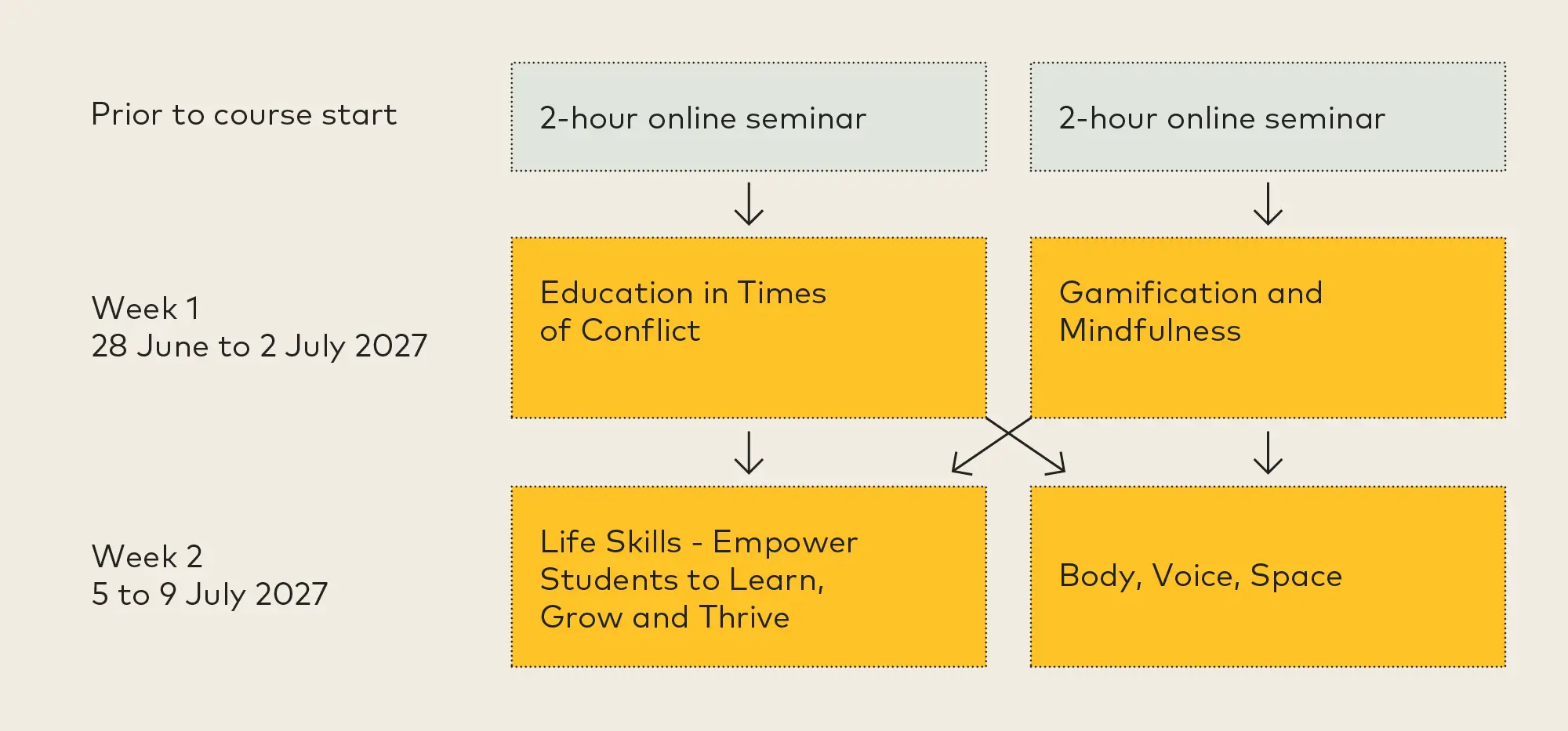
| Option 1 |
Education in Times of Conflict (Course 1) |
Week 1 |
|---|---|---|
|
Life Skills – Empowering Students to Learn, Grow and Thrive (Course 3) |
Week 2 |
|
| Option 2 |
Gamification and Mindfulness (Course 2) |
Week 1 |
|
Body, Voice, Space (Course 4) |
Week 2 | |
| Option 3 | Education in Times of Conflict (Course 1) | Week 1 |
| Body, Voice, Space (Course 4) | Week 2 | |
| Option 4 | Gamification and Mindfulness (Course 2) | Week 1 |
| Life Skills – Empowering Students to Learn, Grow and Thrive (Course 3) | Week 2 |
Course 1: Education in Times of Conflict
1 week, 28 June to 2 July 2027
Armed conflicts, political tensions and social polarization increasingly affect classrooms worldwide. Schools are not isolated from these dynamics: discrimination, hate speech, or hostile stereotypes can enter daily interactions between students, teachers, families and communities.
This course explores how education can respond to such challenges by fostering safe and inclusive learning environments, strengthening democratic values, and promoting peaceful coexistence.
Drawing on real-world case studies and current events, we examine how conflicts become manifest in schools – ranging from playground incidents and biased classroom debates to tensions among staff or between school and families. Participants will learn to recognize early signs of discrimination, analyse interaction patterns, and understand underlying motives such as prejudice, fear or racism.
Through workshops, case studies, and collaborative projects, students develop strategies to:
- protect children’s rights and dignity in times of crisis,
- design classroom practices that encourage dialogue, empathy and resilience,
- engage families and communities in constructive partnerships, and
- create whole-school approaches that embed peace education and anti-discrimination policies.
This course integrates theoretical frameworks with practical approaches and hands-on tools to prepare teachers and educators to foster inclusive, respectful, and resilient schools in times of conflict.
Course dates: 28 June to 2 July
Language of instruction: English
Course no: BE.I722
Course lecturers:
Course 2: Gamification and Mindfulness
1 week, 28 June to 2 July 2027
Gamification enriches interactive settings in classrooms. In this course, gamification is meant as collaborative game-like experience that connects through digital and analogue activities for indoor and outdoor settings of schools. We look at game features, take their traits and characteristics beyond badge and score systems and transfer them into real-life environments. Students gain an understanding of how to use various forms of play for learning purposes and how to design gamified lessons that support collaborative learning.
Alongside gamification, the course explores mindfulness and playfulness as ways to develop life skills that support well-being, self-awareness and creativity. In this context, both levels are addressed: the teachers’ competencies and the pupils’ skills. Students will have hands-on experiences, e.g. how to turn a classroom or urban environment into a game and how to play games that facilitate life skills and mindfulness. Learning will happen through analysing, playing, and reflecting on creative activities, looking into their own play cultures, discussions and creating their own games. We will be in the classroom, the city, and on field trips. As a final assignment, students will create their own gamified lesson.
Course dates: 28 June to 2 July 2027
Language of instruction: English
Course no: BE.I780
Course lecturer:
Course 3: Life Skills – Empowering Students to Learn, Grow and Thrive
1 week, 5 to 9 July 2027
This international Summer School invites you to explore the teaching of life skills and discover how it can support learning, healthy development and well-being in an ever-changing world.
Starting with the roots of life skills education and its links to health education, we will examine various approaches and their application in diverse educational contexts. Particular attention will be given to different target groups, including refugees, students from ethnic minorities and young people facing crises. We will also examine how life skills education can support students during important transitions, such as the move from school to the labour market.
The Summer School combines theoretical input with practical teaching and experiential learning, using examples form international projects. You will explore how growth mindset, motivation and self-efficacy can promote learning and well-being and experience how play and cooperative outdoor games can foster life skills. You will also reflect on how to design such learning experiences while allowing students to explore, collaborate and find their own solutions.
Through exchange and collaboration with students from different countries and educational backgrounds, you will gain new perspectives and inspiration for your own teaching.
Finally, you will put your ideas into practice by designing a life skills learning activity that you can implement in your own educational context.
Course dates: 5 to 9 July 2027
Language of instruction: English
Course no: BE.I712
Course lecturer:
Course 4: Body, Voice, Space
1 week, 5 to 9 July 2027
This course is not about putting on a play or learning acting techniques. Instead, it explores how drama-based strategies can be used as powerful tools for teaching and learning across the curriculum – from science to history, from language arts to ethics.
Drama-based pedagogy is a holistic, embodied approach in which students, pupils, and teachers immerse themselves in fictional scenarios to explore real-world content, develop new perspectives, and deepen their understanding of themselves and others. In this course, we will begin with accessible entry-level strategies and progress towards longer, immersive process dramas in which participants collaboratively problem-solve within imagined contexts – always with a clear connection to curricular goals.
This hands-on course offers practical, transferable ideas for a wide range of classrooms and subjects. At its core lies the development of interdisciplinary competencies – listening, collaborating, communicating, and demonstrating empathy – skills that have been highlighted by curriculum reforms in Switzerland and internationally. These are not only the competencies that future employers are looking for; they are the foundation of meaningful learning in any classroom.
Course dates: 5 to 9 July 2027
Language of instruction: English
Course no: BE.I771
Course lecturer:
Fees
Students from partner universities of PH Zurich benefit from a reduced programme fee, provided they are nominated by their home university.
Fees for students at partner universities and other interested parties
| Number of weeks | Costs for nominated students from partner universities in CHF | Costs for other interested parties in CHF |
|---|---|---|
| 2 | 390 | 790 |
| 3 | 450 | not available |
The programme fee includes:
- public transport in the city of Zurich for the duration of the stay
- weekly social and cultural programme with welcome and farewell get-togethers, chocolate or cheese events
- one day trip to the Swiss mountains at the weekend
The programme fee does not include health, accident and travel insurance or the cost of visas, travel, medical treatment, meals, accommodation, optional events, additional individual excursions and personal expenses.
Admission and application
Swiss and international students from the fields of education sciences, pedagogy, and/or teacher training (Bachelor’s and Master’s degree level) who have completed at least one year of full-time studies by the start of the Summer School may apply to attend.
The Summer School courses are conducted in English, requiring participants to have English skills at a B2 level according to the Common European Framework of Reference for Languages (CEFR). Applicants from institutions that do not have an exchange agreement with PH Zurich must provide proof of their language skills.
Blended Intensive Programme (BIP) – how to apply for a SEMP grant
The PH Zurich Summer School is organised as a Blended Intensive Programme, a BIP. Students from our European partner universities are invited to apply to us for a SEMP grant of approximately CHF 400 for the two-week programme. Please ensure that you tick the appropriate box when submitting your application.
Applications
The application window is open from 1 November to 30 April (late applications are accepted depending on course availability). Places are limited: applying early increases the chance of getting a place.
Students who need to apply for a visa for their stay in Switzerland are advised to apply early.
Preparations for your stay
Before applying, please obtain information on travel requirements, insurance and liability as well as how to arrange accommodation.
Visa
Students coming from EU and EFTA countries do not need a visa for their time in Switzerland. You do need a valid passport to enter the country.
Students coming from non-EU/EFTA countries should contact the Swiss consulate or embassy in their home country to find out whether entry permits and visas are required.
Switzerland is part of the Schengen area. The website of the Federal Department of Foreign Affairs (FDFA) contains further information on travelling to and staying in Switzerland and requirements in terms of identification documents and visas by nationality.
Insurance
Participants are responsible for taking out an international insurance policy. This could take the form of travel insurance, for example, which covers medical expenses, liability, accidents and repatriation to the country of origin in the event of an emergency. Liability insurance is also advisable. Make sure that your insurance policy covers your stay abroad.
Liability
PH Zurich is solely responsible for the quality of the programme. Participants are responsible for travel arrangements and their stay in Switzerland.
Accommodation
Participants are responsible for their own accommodation. PH Zurich has pre-reserved rooms in some places.