Higher education development, teaching and learning
Auch auf Deutsch verfügbar
Content of this page
The Zurich University of Teacher Education is expanding research activities on teaching and learning in higher education building on extensive expertise in faculty development of the Centre for Teaching and Learning in Higher Education as well as on the research capacity of the Centre for Education and Digital Transformation. In partnership with the University of Zurich, a DIZH bridge professorship in “Digital Higher Education Didactics” has also been established.
Research focuses
Teaching and learning to promote epistemic agency and knowledge creation
This research area focuses on the investigation and design of teaching and learning processes in tertiary education at both micro and meso levels. A central emphasis is placed on fostering dispositions and competencies such as epistemic agency – the ability of students to critically evaluate, generate, apply, and transform knowledge. The aim is to empower learners to navigate the educational process autonomously while taking on active roles as responsible agents in a knowledge society. This emphasis on agency does not diminish the importance of subject-specific knowledge but rather promotes an integration of knowledge construction processes, competencies, and attitudes.
The research activities aim to explore how learning environments can be designed to encourage students to question, recombine, and further develop knowledge. Special attention is given to the use of digitally supported teaching and learning formats that facilitate these processes in an increasingly digital world. This includes, for example, the study of effective and autonomy-enhancing feedback and assessment approaches – especially in light of developments in the field of artificial intelligence – and the promotion of data and algorithmic literacy.
A particular focus lies on researching competence development in the dynamic field of digital transformation, with the goal of supporting the acquisition of essential skills for an increasingly digital life and work environment. Furthermore, we engage in shaping effective and future-oriented learning environments to contribute to a holistic and transformative learning experience in higher education.
Study programmes and organisational development
This research area focuses on examining the impact of curricular structures (e.g., transitions into higher education) as well as the strategic planning and development of curricula and related organisational processes in initial and continuing education. Key themes include the strategic orientation and design of modules, as well as the challenges of transition and transformation encountered in the advancement of study programs.
This involves systematic analysis of study programs and the promotion of competency development and capacity building. Another focus is the contribution of educational technology approaches to the development and implementation of digitally supported programs. Evaluating digitalisation strategies and their effects on both organisational and individual levels provides valuable insights for the advancement of digital education formats.
Policy and strategic initiatives are analyzed with regard to their implementation and impact dimensions, with the goal of deriving practical and actionable recommendations.
The research activities focuses its efforts on three different levels and takes into account a wide range of perspectives to ensure a comprehensive analysis of the educational landscape.
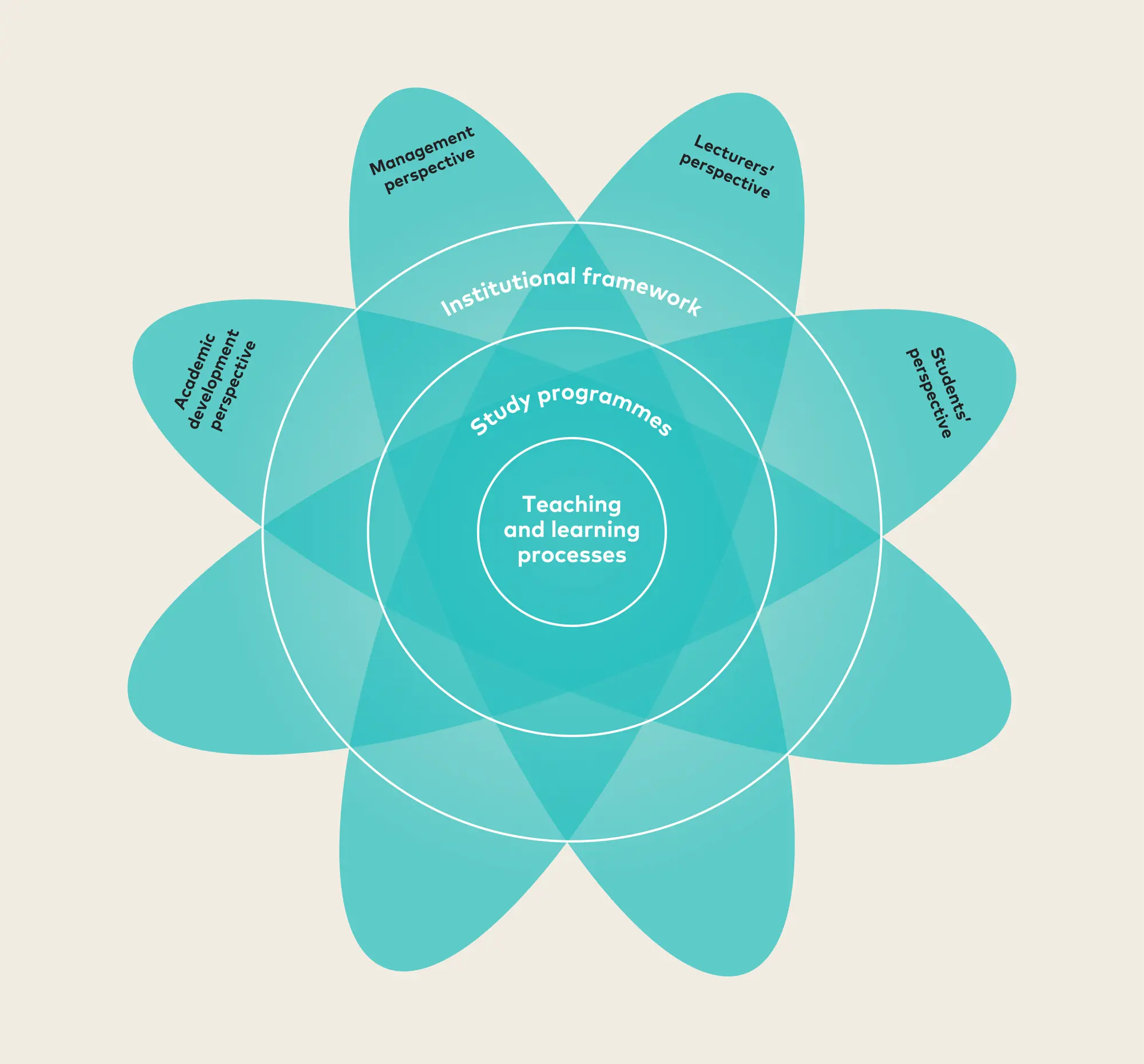
Teaching and learning processes in different learning settings are addressed at a micro level. However, the research also explores the cumulative effect at the level of entire programmes of study as well as at the level of overarching institutional conditions.
Depending on their area of focus, the research projects examine not only the perspectives of students and teaching staff, but also the viewpoints of university management and those working in teaching and learning in higher education.
Projects
Events and recordings
Webinar Series: Rethinking Knowledge? Epistemic Agency and AI in Higher Education (2025/2026)
This three-part webinar series explores how artificial intelligence (AI) is reshaping fundamental assumptions about knowledge and learning in higher education.
Together, we will critically examine what counts as knowledge across disciplines and consider how AI challenges or changes these epistemic traditions. At the heart of this series is the concept of epistemic agency – students’ capacity to actively evaluate, use, create, and transform knowledge. In an era of misinformation, “post-truth” politics, and generative AI, universities must more than ever foster students’ critical engagement with knowledge.
Across the three sessions, participants – higher education instructors, academic developers, and interested faculty – will build a shared understanding of epistemic agency, explore how it manifests in different disciplines, and co-develop actionable strategies to empower students as active knowers in the age of AI. Each webinar builds on the last, culminating in concrete tools and insights for teaching practice.
Webinar 1: Fostering Epistemic Agency in Higher Education: Why and How?
Juuso Nieminen
Tuesday, 4 November 2025, 9.30–10.30h
The opening session introduced the foundational concept of epistemic agency (EA) and why it matters in today’s educational landscape. Juuso Nieminen provided a conceptual grounding in EA – defined as students’ capability to agentically evaluate, produce, use, and transform knowledge. He also made the case for why epistemic agency is not simply another “soft skill”, but a critical competence for navigating AI-rich environments and essential for meaningful teaching and assessment in higher education today.
Webinar 2: How Does AI Reshape Knowledge? Disciplinary Perspectives
Wednesday, 26 November 2025
Format: Live panel discussion with disciplinary experts (Juuso Nieminen returned as a discussant, joined by invited panellists from diverse fields)
Building on the conceptual foundation of Webinar 1, this session explored how different academic disciplines define, value, and produce knowledge – and how these traditions are being reshaped by AI. Each discipline (e.g., STEM, social sciences, humanities, professional fields) has distinct epistemological cultures and assumptions about what counts as knowledge. These assumptions influence not only academic research but also what universities expect students to learn and how they are assessed.
In this panel, scholars from varied disciplines examined how AI is affecting knowledge practices in their fields: What new opportunities or tensions are emerging in teaching and research? What are shared concerns – such as critical thinking – and where do fields diverge in their expectations (e.g., evidence standards, objectivity vs. interpretation)? The discussion helped us consider whether epistemic agency takes different forms in different contexts, and how AI may require us to reimagine – or reaffirm – those disciplinary perspectives.
Webinar 3: Teaching for Epistemic Agency: Strategies and Directions
Wednesday, 14 January 2026
Format: Interactive workshop with expert facilitation
In this final webinar, we move from reflection to action. Drawing on the conceptual insights of Webinar 1 and the interdisciplinary perspectives of Webinar 2, this interactive session focuses on practical strategies for fostering epistemic agency in the classroom: What can educators do to support and develop students’ epistemic agency in an AI-rich educational context?
Through group activities and guided facilitation, participants will explore concrete methods for helping students critically engage with knowledge in AI-influenced educational contexts. By the end of the session, participants will leave with actionable ideas, real-world examples, and possibly a sense of community to continue keeping knowledge and student agency at the center of higher education.
Webinar Series: Embracing AI – Navigating Transformative Disruptions in Higher Education (2024/2025)
The rapid changes in society, characterized by events like the pandemic and the ongoing digital transformation, pose significant challenges for higher education institutions. These challenges include the rapid integration of artificial intelligence (AI), particularly generative AI technologies such as Chat-GPT, which requires comprehensive responses from both individual actors and entire institutions.
Our webinar series, “Embracing AI: Navigating Transformative Disruptions in Higher Education”, focuses on tackling these multifaceted challenges. We aim to bridge the gap between individual and organizational development, offering insights into how to adapt educational strategies to technological advancements. The events in this series will present research showing how research can help higher education institutions develop effective routines for integrating AI, address dilemmas, and foster agility in the face of future societal changes.
Generative AI in Higher Education Research: 4M Framework of Change and Impact
Lori Goff, director of MacPherson Institute for Leadership, Innovation and Excellence and Erin Aspenlieder, McMaster University, Canada
3 June 2025, 15–16.30h
The discussion is grounded in the 4M framework (Micro, Meso, Macro, and Mega levels) of institutional impact and change, demonstrating how higher education research can be framed at each of these levels. Participants will engage in activities to understand the 4M model, discuss local experiences, and generate research questions at each level to shape the future of higher education.
Everything under Control? Aligning individual and organizational developments in higher education in the context of GenAI
Prof. Barbara Getto, PH Zurich, Franka Marie Herfurth, University Rostock, Judit Martínez Moreno, Researcher, PH Zurich and Maria Misiutin, Researcher, PH Zurich
18 March 2025, 14–15.15h
The higher education system plays a crucial role in preparing individuals for an increasingly digitalized world. In response to rapid developments, universities are developing strategies to cope with technological change (such as GenAI) and find their positions. The influences of digitalization affect both the institutional and individual levels, manifesting as disruptive innovations within educational organizations. The question arises as to the extent to which normative strategies in the sense of a top-down process operate within universities and how they relate to digitalization processes that are also initiated by the individual dispositions of educators, thus corresponding more to a bottom-up approach.
As part of a study conducted at universities in Germany and Switzerland, the congruences and interactions of strategies at the macro level with teaching at the micro level, as well as the individual dispositions of educators, are investigated.
Behind the GenAI Policies: A Critical Examination of the underlying Conceptions of Assessment in Higher Education
Mònica Feixas, Center for Teaching and Learning in Higher Education, PH Zurich
28 January 2025, 14–15.15h
This webinar presented a comparative analysis of university AI policies in Switzerland and Spain, examining how assessment and academic integrity are embedded in current institutional regulations on AI. The study is based on Bacchi’s (2021) problematisation theory and Chan’s (2024) AI Ecological Education Policy Framework, which distinguishes three key dimensions of GenAI integration: pedagogical, governance-related, and operational.
The discussion focused on how these policies construct challenges and opportunities related to AI, which aspects are emphasized, which remain unaddressed, and what underlying assumptions shape institutional responses. It invited you to reflect on the role of AI in assessment and discussed how university policies can better align with the evolving demands of higher education in the so-called post-plagiarism era.
Symposium: Approaches to Research in Higher Education Teaching and Learning (2023)
Approaches to Research in Higher Education Teaching and Learning
Symposium 20–21 November 2023
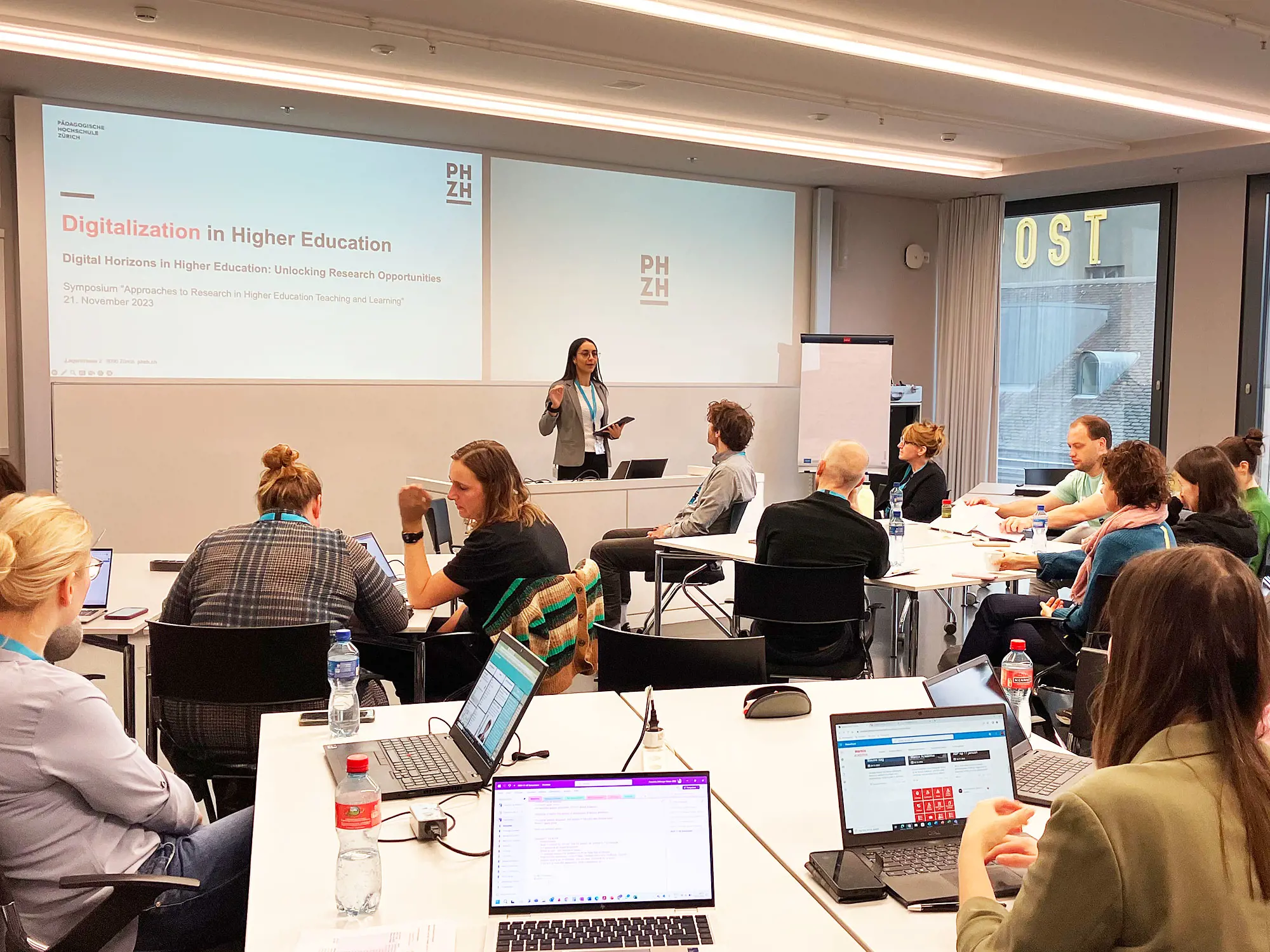
The symposium created a platform for a vivid exchange of perspectives and projects on key issues in Higher Education, with a particular focus on teaching and learning. In pursuit of this goal, advanced researchers together with doctoral students from across Europe joined and shared their insights and contributions.
The symposium was framed by two keynotes:
The symposium centered around three overarching themes. Firstly, it delved into the theory-practice relationship in profession-oriented Higher Education, addressing the incorporation of professional practice into research and the challenges surrounding research-based learning. Secondly, it examined the crucial aspect of assessment for learning, emphasizing the alignment of learning objectives, methods, and assessment techniques and their impact on student outcomes. Lastly, the symposium explored the field of digitalization in education, acknowledging the transformative potential of educational technology and the evolving landscape of higher education in the digital age, particularly in light of artificial intelligence’s influence.
Webinar Series: Self-regulated Learning (2022)
Fostering Student’s Self-Regulated Learning in Higher Education
Dr. Maria Theobald DIPF, Leibniz-Institute for Research and Information in Education
Tuesday 27 September 2022, 14–15.30h
Self-regulated learning constitutes a key competence for academic achievement. However, many students show difficulties in self-regulating their study activities. In the first part of this webinar, typical self-regulatory challenges for university students are discussed based on a study in the context of online education. In the second part of this webinar, ways to foster students’ self-regulated learning are discussed.
Self-regulated learning, patterns in student learning and implications for teaching
Prof. Dr. Jan Vermunt, Eindhoven University of Technology
Tuesday 10 May 2022, 14–15.30h
Over the last decades, we’ve witnessed a shift in higher education pedagogies towards encouraging students to actively self-regulate their learning and construct their own knowledge instead of passively following teachers’ directions and consuming knowledge provided by others. This shift is accompanied by an increasing interest in how students learn in higher education and in the antecedents and consequences of their approaches to learning.In this webinar, research in this field will be shared and discussed.
Webinar Series: Student Engagement (2021)
Practice in the educational interface: Understanding student diversity
Dr. Ella Kahu Massey University, Wellington NZ
Tuesday 13 April 2021, 8–10 am
Higher education students are increasingly diverse in their past experiences and current life situations. In this webinar Ella Kahu will provide insights from her research with first year students on how the dynamic interplay between the students and institutional practices within the «educational interface» impacts on first year student engagement and success.
The role of educational technology in fostering student engagement
Dr. Melissa Bond, University College London UK
Monday, 27 September 2021, 2–3 pm
The effective use of technology in education has never been so vital. This webinar will discuss the concept of student engagement and the role that technology can play in enhancing the student experience, drawing on evidence. It will also provide participants an opportunity to explore and workshop the use of an engagement framework, to inform future practice.
Engaging students as partners – A critical review
Prof. Dr. Peter Felten, Elon University, USA
Tuesday, 31 August 2021, 2–4 pm
A movement toward “students as partners” has swept across much of global higher education over the past decade. This webinar will critically consider the research on and practices of engaging teaching and learning partnerships, focusing in particular on questions of power and the nature of educationally purposeful relationships.
Publications
2026
Feixas, Mònica, Ion, Georgeta, Pirovino, Liana, & Barrobés, Mireia (2026) Behind the genAI Policies: A critical examination of the underlying conceptions of assessment in higher education.
The Journal of Adult Learning, Knowledge, and Innovation (JALKI)
Flepp, Gabriel, Feixas, Mònica (2026) Mehr als nur ein Bewertungsraster. Der Reflective Companion als Impulsgeber für eine transformative Hochschullehre.
In: Blume, D., Volk, B., (eds.), Hochschullehre Im Digitalen Zeitalter. Theorie und Praxis zukunftsfähiger Lern- und Lehrprozesse. Medien- und Gestaltungästhetik 21. (181–194). Bielefeld: Transcript
Greif, Carina, Schmocker, David, Matti, Thomas, Klarer, Franziska, Blume, Dana, Woschnack, Ute, Feixas, Mònica (2026) Assessing the assessment. A deep dive into assessment phases and the use of AI Support.
In: Blume, D., Volk, B., (eds.), Hochschullehre Im Digitalen Zeitalter. Theorie und Praxis zukunftsfähiger Lern- und Lehrprozesse. Medien- und Gestaltungästhetik 21. (197–226). Bielefeld: Transcript
2025
Baumgartner, Simon (2025) Eine Interventionsstudie zur Förderung der ICT-Kompetenz in einem Tagesschulangebot.
Berlin: Refubium.
Binder, Sabine and Liana Pirovino (2025) Promoting Literary Reading in Lower Secondary English Language Classrooms.
Children’s Literature in English Language Education 13(1): 76–106.
Richter, Eileen, Markus Wolfgang Hermann Spitzer, Annabelle Morgan, Luisa Frede, Joshua Weidlich and Korbinian Moeller (2025) Large Language Models Outperform Humans in Identifying Neuromyths but Show Sycophantic Behavior in Applied Contexts.
Trends in Neuroscience and Education 39: 100255.
Getto, B. (2025) Hochschullehre im Kontext der Digitalisierung.
In: N. Vöing (Hrsg.), Praxishandbuch Hochschullehre II: Bewertung, Digitalisierung und Barrierefreiheit. Bielefeld: Transcript.
Weidlich, J., Fink, A., Jivet, I., Gombert, S., Giorgiashvili, T., Yau, J., & Drachsler, H. (2025) Highly informative feedback using learning analytics: How feedback literacy moderates student perceptions of feedback.
International Journal of Educational Technology in Higher Education, 22(1), 1–16.
Weidlich, J., Gašević, D., Drachsler, H. & Kirschner, P. (2025) ChatGPT in education: An effect in search of a cause.
Weidlich, Joshua, Flurin Gotsch, Kai Schudel, Claudia Marusic-Würscher, Jennifer Mazzarella, Hannah Bolten, Dario Bütler, Simon Luger, Bettina Wohlfender and Katharina Maag Merki (2025) Teacher, peer, or AI? Comparing effects of feedback sources in higher education.
Computers and Education Open 9: 100300.
Weidlich, J., Jivet, I., Woitt, S., Orhan Göksün, D., Kraus, J., & Drachsler, H. (2025) The student feedback literacy instrument (SFLI): Multilingual validation and introduction of a short-form version.
Assessment & Evaluation in Higher Education, 50(7), 1–17.
Xu, Kate M., Lijia Lin, Margareta Gorter, Sascha Schneider, Joshua Weidlich, Robert O. Davis, Karel Kreijns and Renate de Groot (2025) Social Presence: A Key Factor in Embedding a Pedagogical Agent into Online Learning in Primary Education.
British Journal of Educational Technology 57(1): 1–16.
Zellweger, Franziska, Arnd Brandl, Monika Albrecht and Petra Weiss (2025) Wie viel Normativität (v)erträgt die Hochschule: Das Potenzial der Konstruktiven Kontroverse.
Die Hochschullehre 11(74): 883–90.
Zellweger, Franziska (2025) Die “PH-Bubble”? Thesen für mehr Durchlässigkeit und Diversität in der Führung.
In: Zwei Jahrzehnte hochschulische Lehrerinnen- und Lehrerbildung: Bilanzierungen und Perspektiven = Deux décennies de formation des enseignant·e·s en haute école: bilans et perspectives, hrsg. v. Bruno Leutwyler, Deniz Gyger Gaspoz, Barbara Kohlstock, Heinz Rhyn und Peter Tremp, 395–400. Bern: Hep.
Zsindely, Piroska, Jessica Pehlke-Milde, Astrid Braun, Nina Lutz, Liana Pirovino and Jeannette Wick (2025) Berufsbildner*in: Brücken zwischen Praxis und Theorie.
Obstetrica 122 (2): 34–35.
Berk, Michelle, Delorenzi, Erica, Schwartzman, Gisela, Durante, Eduardo, & Feixas, Mònica (2025) Transfer of Educational Knowledge into Teaching Practices in Health Sciences. (La transferencia de conocimientos educativos a las prácticas docentes en ciencias de la salud.)
Estudios pedagógicos (Valdivia), 51(1), 179–194.
Zellweger, F. & Hauser, I. (2025) The power of metaphors to communicate about the first-semester experience
Poster-Präsentation. EARLI Conference Graz.
2024
Axelsson, C., & Getto, B. (2024) Kulturen des Wandels: Transformation der Hochschulbildung im Digitalen.
In: Bildung, Praxistransfer und Kooperation: Kompetenzentwicklung für die Hochschullehre in Netzwerken. (S.23–29).
Feixas, M. & Flepp, G. (2024) The “Reflective Companion”: a self and peer-assessment resource to analyse reflexivity in portfolios.
In: Axelsson, C., Blume, D., Volk, B., (eds.), Kompetenzentwicklung in kooperativen Netzwerken, Lela – LernLabor Hochschuldidaktik (Media and Design Aesthetics, vol. 19). Bielefeld: Transcript.
Getto, B. (2024) Bildung in Zeiten der Unsicherheit: Wie können wir den digitalen Wandel gestalten?
In: M. Lindenau & S. Stiehler (Hrsg.), Umgang mit Ungewissheit und Unsicherheit. Frankfurt/New York: Campus.
Haldemann, R., Sender, A., Stucki-Sabeti, S., Kocher, M., Zellweger, F., Eckhardt, C., Strauss, N.-C., Merz, N., Vollmer, A., & Rack, O. (2024) Teams als Lernorte: Ansätze zur Entwicklung des doppelten Kompetenzprofils in Hochschulteams.
Schlussbericht. PH Zürich, Hochschule Luzern & Fachhochschule Nordwestschweiz.
Klein, C.; Schmocker, D.; Boos, M. & Feixas, M. (2024) Beyond comments: Facilitating constructive feedback through technology.
In: Axelsson, C., Blume, D., Volk, B., (eds.), Competence development in cooperative networks, Lela – LernLabor Hochschuldidaktik (Media and Design Aesthetics, vol. 19). Bielefeld: Transcript.
Petri, P. S., Krempkow, R., Ebner, M., & Getto, B. (2024) Digitale Kompetenzen – Zur Rolle dieser “Future Skills” im Hochschulkontext: Definition und Bedeutsamkeit, Messung und Förderung.
Editorial. Zeitschrift für Hochschulentwicklung, 19(1), 9–24.
Weidlich, J., Fink, A., Jivet, I., Yau, J., Giorgiashvili, T., Drachsler, H., & Frey, A. (2024) Emotional and motivational effects of automated and personalized formative feedback: The role of reference frames.
Journal of Computer Assisted Learning, 40(6), 2735–2752.
Zellweger, F., & Getto, B. (2024) Organisationales Lernen in der Krise? Zur Wirksamkeit von Digitalisierungsstrategien von Pädagogischen Hochschulen und Fachhochschulen in der Pandemie.
In: C. Quesel & P. Hirsch (Hrsg.), Die «Corona-Lektionen» Pädagogischer Hochschulen: Evaluationen und Studien zur Lehre im Kontext der Corona-Pandemie (S. 179–198). Verlag Barbara Budrich.
Zellweger, F., Brahm, T., & Kocher, M. (2024) Factors supporting the engagement of first-semester students in teacher education.
Swiss Journal of Educational Research, 46(1), 47–60.
Kocher, M., Zellweger, F., Eckhardt, C., Strauss, N.-C., Stucki-Sabeti, S., Haldemann, R., Merz, N., Vollmer, A., & Rack, O. (2024) Teams als Lernorte. Kurzinterventionen.
PHZH, HSLU, FHNW.
Almonacid-Fierro, A., Sepúlveda-Vallejos, S., Aguilar-Valdés, M., & Feixas, M. (2024) Bridging the Gap Between Teaching and Research: Voices of University Teachers. (Tendiendo puentes entre docencia e investigación: Voces de docentes universitarios.)
Estudios Pedagógicos, 50(3), 59–77.
Feixas, M. (2024) Los desafíos de las comunidades académicas: innovación e investigación en docencia universitaria para la pertinencia y calidad en educación superior.
Estudios pedagógicos (Valdivia), 50(3), 7–12.
Weidlich, J.; Yau, J.; Kreijns, K. (2024) Social presence and psychological distance: A construal level account for online distance learning.
Education and Information Technologies.
2023
Getto, Barbara and Michael Kerres (2023)
Mediendidaktik und ihr Beitrag zu Hochschulentwicklung.
In: Hochschuldidaktik als Wissenschaft, hrsg. v. Rüdiger Rhein und Johannes Wildt, 211–26. Bielefeld: Transcript.