Reinforcement of teacher training : Expanding teaching languages and literacy across Mali
Switzerland’s four official languages and multilingual tradition are often a source of national pride. However, this pales in comparison to Mali, which is home to more than 80 languages. But until 2023, French was the only official language and Malian schools therefore based literacy almost entirely on French, despite the fact that most children speak other languages at home. This has resulted in one of the region’s most persistent challenges: Although literacy rates are improving, around half of 15- to 24-year-olds cannot read and write a short statement about their everyday lives. Research shows that children learn to read faster and more effectively when they are first taught in their mother tongue. The Malian authorities have long recognised this. With 13 national languages now enshrined in the constitution as official languages, the country is renewing its commitment to teaching children in their mother tongues.
Hybrid trainings for students and teachers all over Mali
PH Zurich’s Department for International Projects in Education is participating in this effort. Mandated by the international development consultancy Particip GmbH and funded by the Swiss Agency for Development and Cooperation, PH Zurich has supported the Programme for the Reinforcement of Teacher Training (AREN) in Mali since 2024.
As part of the project, Malian language specialists and course designers are developing online courses for pre-service and in-service teachers with the aim of bolstering their competencies in the different national languages. The courses combine self-paced online learning on a Moodle platform with local tutoring, and have so far been developed in eight languages: Bamanankan, Fulfuldé, Dogoso, Songhay, Boomu, Tamasheq, Malingakan and Kassonke. PH Zurich’s language education experts, Tamara De Vito and Jacqueline Egli, together with project lead Corinne Pernet, advise the Malian experts and contribute ideas from Swiss language teaching methodology: “The challenge was to adapt our language teaching expertise to the Malian social, technical and didactic-methodological reality in order to provide meaningful input and feedback.” A challenge successfully met, as Papa Youga Dieng, Team Leader of AREN, confirms: “The collaboration with PH Zurich enables us to combine the expertise of the Malian teams with high-quality methodological support, allowing us to develop training programmes tailored to Mali’s linguistic realities and the needs of future teachers.”
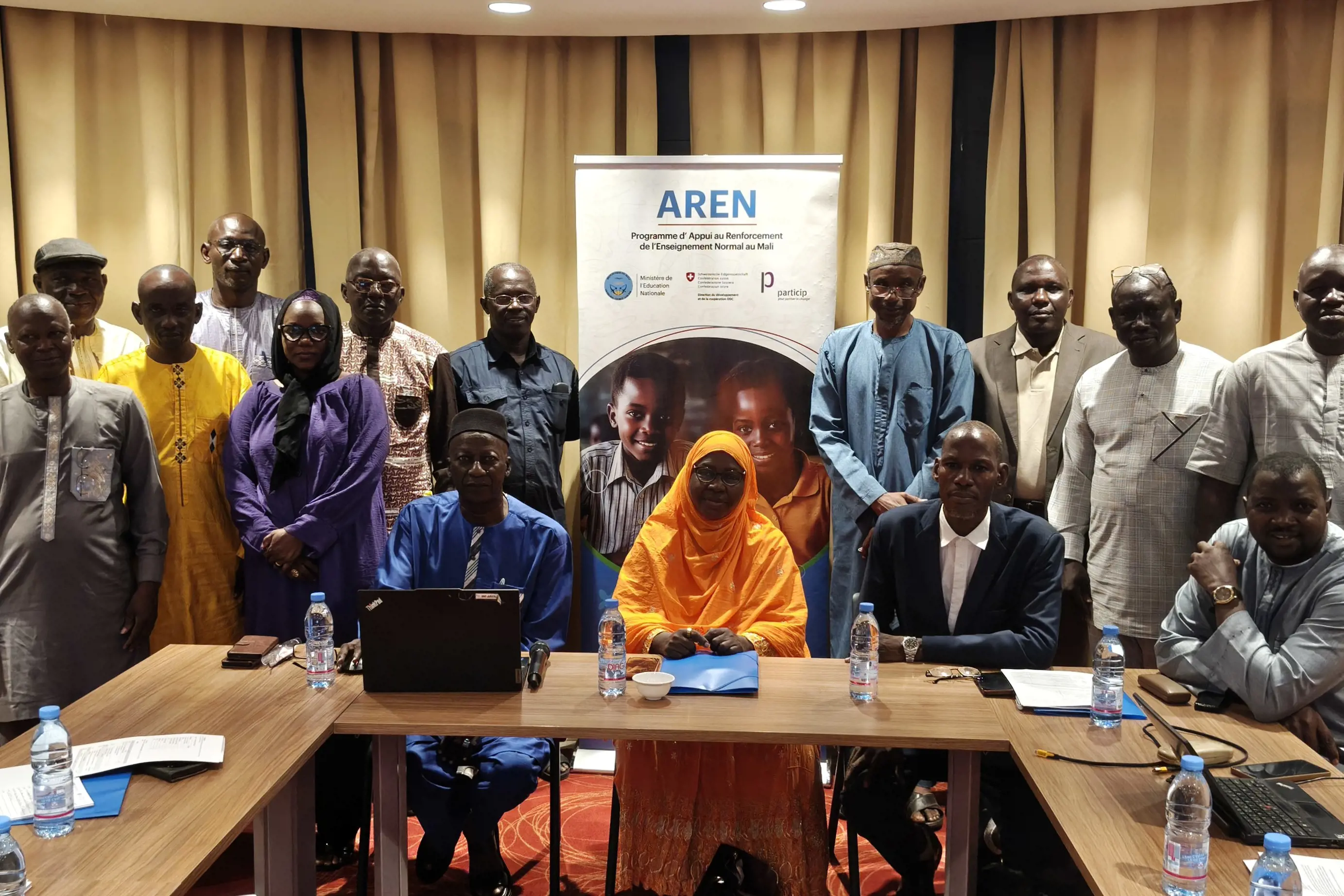
Thanks to the hybrid format, the courses have reached students and teachers across the country, including those in remote areas far from major cities. This includes the southern regions around Sikasso and Bougouni, the central Mopti area, and more northern places such as Gao, Tombouctou, as well as remote towns near the Sahara, including Gossi, Léré and Tonka. The security situation in these areas remains fragile due to repeated conflicts between the government, rebels and separatists in northern Mali. Therefore, sustaining teacher training under these conditions is not something to take for granted, which is precisely why it matters.
Five more languages to implement
With almost 3,000 current or future teachers having taken the course by the end of July, the designers and tutors are currently responding to participants’ feedback. Grammar explanations are being simplified, some exercises cut, others added, all with the aim of providing an even better learning experience for the next generation of teachers. In autumn, the teams will develop online courses for a further five national languages. The aim remains the same: To provide teachers with the means to teach effectively in a language their pupils understand.
PH Zurich’s international services
AREN is one of several current projects run by the Department for International Projects in Education. With many years of experience in educational development cooperation, it offers a wide range of services for international target groups.