Expanding Horizons : The Role of Internationalisation in Teacher Education
It was a busy lunchtime on 5 March 2025 on the campus of the Zurich University of Teacher Education. In numerous classrooms and on the campus square, students presented the universities, they had visited as exchange students during the previous semester – from universities in the other language regions of Switzerland to institutions all over Europe, North America, Asia and Australia – and shared their experiences. Virginia Celia Kaeser, for example, talked about how her stay in Norway introduced her to the concept of “Friluftsliv”, which involves activities and time spent in nature, and which Virginia now wants to apply to her career as a kindergarten teacher. Or Carey Albiez, who studied in Australia for a semester and was particularly inspired by the close relationship between teachers and students there.
An image gallery with 16 images follows.


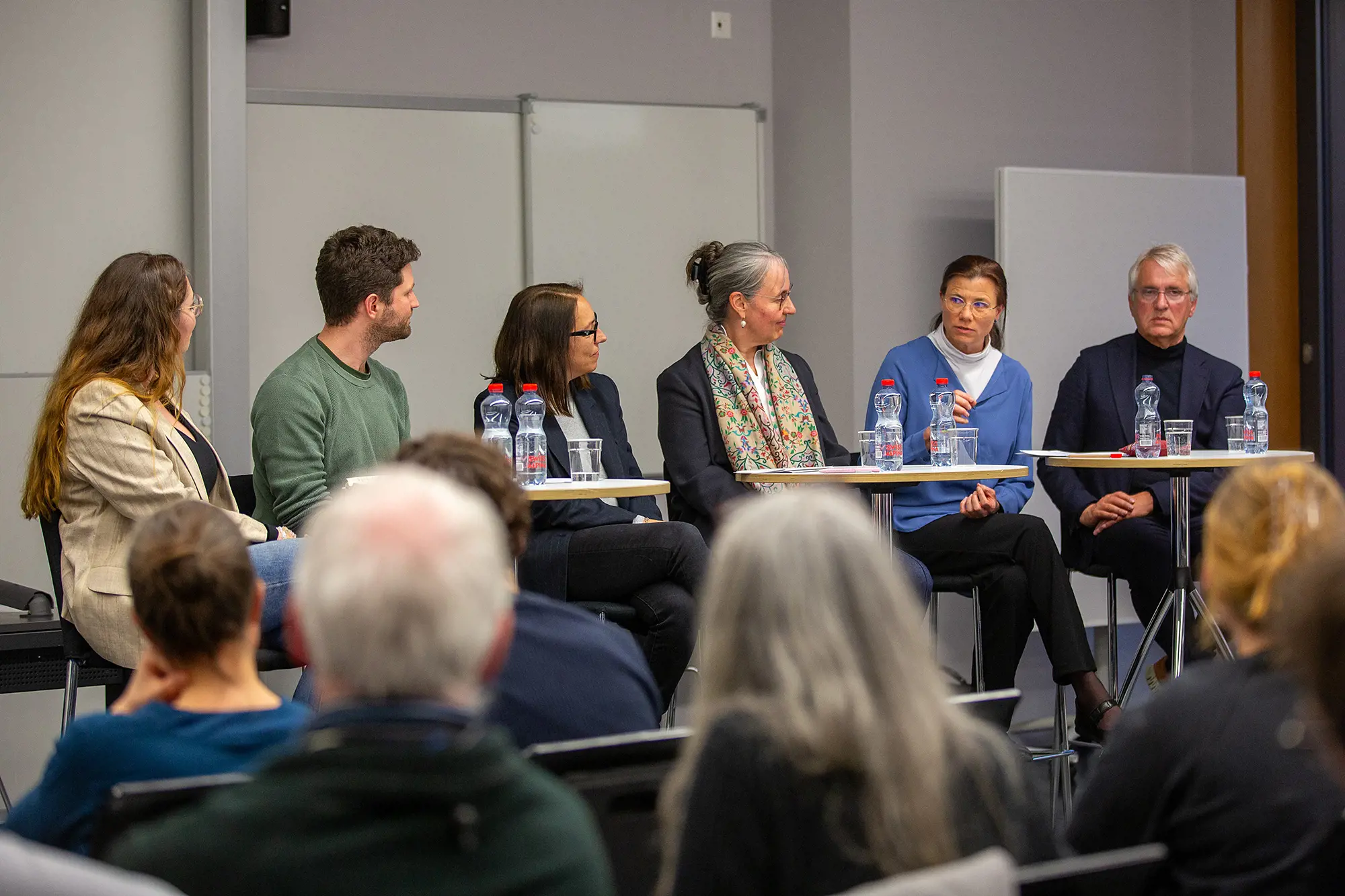
In addition, students from the “Global Learning” elective presented their experiences as part of projects run by the Department for International Projects in Education. According to student Laura Bächer, this elective is particularly suitable for students for whom an exchange semester is not possible for financial or time reasons, but who are still interested in engaging with students from other countries. The “Global Learning” elective is open to all students of the Lower Secondary Degree Programme. In the evening, Jan Karel Verheij, a long-standing Senior Lecturer in Education Science at the Marnix Academie in Utrecht, gave a keynote speech followed by a panel discussion with lecturers, teachers and students on the topic “Internationalisation of Universities of Teacher Education: More than just preparing for diversity in the classroom”. The panel members agreed that the potential of exchange experiences lies in breaking habits and changing perspectives. It is not the distance travelled that is important, but rather that these experiences are made at all and then reflected upon. And the home university can also benefit significantly from the returning students if they can easily incorporate their didactic and content-related insights – as was evident at the International Day.
In the following interview, Jan Karel Verheij presents the main points from his keynote speech and gives an insight into the opportunities and challenges of internationalisation in teacher education.
Jan Karel Verheij, beyond diversity in the classroom, what are the broader goals and benefits of internationalisation in teacher education?
Internationalisation is a broad concept that encompasses much more than just the diversity that teachers encounter in the classroom. In my view, internationalisation revolves around three main themes:
- Personal Development: Internationalisation helps students to develop independence, self-confidence, adaptability and creativity. Exposure to the contexts of different cultures and countries can encourage students to explore different perspectives, deal effectively with stressful situations and develop a clear vision for their future.
- Sustainability and Global Citizenship: Exposure to global challenges such as the climate crisis and social inequality strengthens students’ global citizenship. It helps them understand the interconnectedness of local and global issues and encourages sustainable behaviours and solutions. By integrating these elements into teacher education, individuals and societies are better prepared for the challenges of the 21st century.
- International Competencies: Through internationalisation, students develop an orientation in their field and are able to recognise the cultural framework of their discipline. They are able to gain insight into professional practices across cultures, develop their conflict management skills and improve their language skills, which are crucial for collaboration in many contexts.
Ultimately, internationalisation prepares future educators to navigate and contribute to an increasingly complex world. Throughout my long career I have seen many positive examples of this, whether in increased awareness of sustainability issues, greater sensitivity to cultural differences, or the ability to develop and express their own opinions. Both national and international research supports these personal observations. This is why the Dutch Education Council advocates that every student should leave the education system with strong international competences, ready to communicate and cooperate across borders.
What challenges do universities face in implementing internationalisation strategies in teacher education?
Integrating internationalisation into the curriculum requires a clear vision. But curriculum development is a highly complex process that many universities and colleges struggle with. As a result, internationalisation has often been an afterthought. However, the International Competencies (ICOM) framework and UNESCO’s Sustainable Development Goals (SDGs) have helped to raise the profile of internationalisation. In my view, internationalisation should be an integral part of a curriculum, for the benefits mentioned, but also because its implementation becomes much easier if it is an inherent component of education. And while it is good to use the possibilities of online education, curricula must include study abroad programmes, exchange semesters or international study trips, as these experiences add significant value to the already complex teaching profession.
How do you see the future of internationalisation in teacher education developing over the next decade?
I believe that internationalisation will become an increasingly important aspect of education. There are many arguments for this, one of the most important being globalisation. A school – whether in a village or a city – can no longer be considered at a micro level. The school exists in a national context, which is part of a continent, which is part of the world. Many of today’s challenges demonstrate the need for a holistic perspective: to ensure sustainable development, we must think across borders. The current political conflicts affect us all and show how important it is to understand each other. This requires intercultural skills, knowledge and competences. For these reasons, teacher education programmes must produce graduates who are interculturally and transculturally competent and who are adequately prepared for the diverse challenges and complexities of the teaching profession. These graduates will, in turn, be responsible for educating the next generation of students to become responsible global citizens.